
Article: CPAP & Sleep Apnea FAQ 2026 | Complete ResMed Guide
CPAP & Sleep Apnea FAQ 2026 | Complete ResMed Guide
The Complete CPAP & Sleep Apnea Questions and Answers Guide: ResMed Edition
Updated October 2026 | USCPAP.com
CPAP Questions? Start Here.
Being told that you have sleep apnea can create more questions than answers.
What exactly is CPAP?
Which machine do you need?
Should you choose a nasal mask, nasal pillows or a full-face mask?
What does AHI mean?
Why is your mouth dry?
Why does your mask leak?
How often should CPAP equipment be cleaned?
Can you take your machine on an airplane?
What happens if you cannot meet Medicare's CPAP usage requirements?
And perhaps the biggest question of all:
How do you actually get comfortable enough with CPAP to use it every night?
At USCPAP.com, a division of USA Medical Supply, we help people answer those questions every day.
For this updated guide, we are focusing exclusively on ResMed sleep therapy products.
That includes ResMed AirSense 11 AutoSet, AirSense 10 AutoSet, AirMini travel CPAP, AirCurve 11 bilevel therapy and ResMed AirFit and AirTouch masks and accessories.
USCPAP.com is an authorized ResMed dealer, and our West Springfield, Massachusetts retail location has licensed respiratory therapists available to help CPAP users with equipment and therapy questions.
This guide is educational and is not a substitute for advice from your sleep physician, respiratory therapist or other healthcare professional. Do not independently change prescribed therapy pressures or discontinue PAP therapy without consulting your healthcare provider.
PART 1: UNDERSTANDING SLEEP APNEA
1. What is sleep apnea?
Sleep apnea is a condition in which breathing repeatedly stops or becomes significantly reduced during sleep.
These interruptions can prevent the body from getting enough oxygen and can repeatedly disrupt normal sleep.
The National Heart, Lung, and Blood Institute identifies obstructive sleep apnea and central sleep apnea as the two principal types. Obstructive sleep apnea occurs when the upper airway becomes blocked during sleep. Central sleep apnea occurs when the brain does not consistently send the signals needed to breathe.
2. What is obstructive sleep apnea?
Obstructive sleep apnea, or OSA, is the most common type of sleep apnea.
During sleep, tissues and muscles surrounding the upper airway can relax enough that the airway becomes narrowed or blocked.
Breathing may partially decrease or completely stop until the airway reopens.
This cycle can occur repeatedly throughout the night.
3. Is sleep apnea the same thing as snoring?
No.
Snoring can occur when tissues in the airway vibrate as air passes through them, but snoring by itself does not prove someone has sleep apnea.
However, loud snoring combined with witnessed pauses in breathing, choking, gasping or significant daytime sleepiness should be discussed with a healthcare professional.
NHLBI identifies loud snoring, breathing that starts and stops, and gasping for air among common nighttime symptoms of sleep apnea.
4. What are common symptoms of sleep apnea?
Symptoms can include loud snoring, witnessed breathing pauses, gasping during sleep, excessive daytime sleepiness, fatigue, morning headaches, difficulty concentrating, dry mouth and frequent nighttime awakenings.
Some symptoms differ between individuals, and many people do not realize that their breathing is being interrupted because the events happen while they are asleep.
A bed partner is often the first person to notice the problem.
5. Is untreated sleep apnea dangerous?
It can be.
Untreated sleep apnea has been associated with significant health consequences.
NHLBI notes that untreated sleep apnea can increase the risk of serious problems including stroke and heart attack and can affect concentration, memory, decision-making and daytime alertness.
Sleep apnea can also increase the danger associated with driving if excessive sleepiness affects attention or reaction time.
6. How is sleep apnea diagnosed?
Sleep apnea is diagnosed through a clinical evaluation combined with appropriate sleep testing.
Depending on the patient and medical situation, testing may take place in a sleep laboratory or through an appropriate home sleep apnea test.
A sleep study helps clinicians determine whether abnormal breathing events are occurring and, if so, their frequency and characteristics.
7. Can I diagnose sleep apnea from a smartwatch or fitness tracker?
A wearable may identify patterns that encourage someone to discuss sleep with a healthcare professional, but consumer wearable information should not be treated as a replacement for a medically appropriate sleep apnea evaluation.
If you have symptoms suggesting sleep apnea, speak with a qualified healthcare provider about appropriate testing.
8. What does AHI mean?
AHI stands for Apnea-Hypopnea Index.
It represents the average number of apneas and hypopneas occurring per hour of sleep during diagnostic testing.
Medicare defines an apnea as a cessation of airflow lasting at least 10 seconds under its coverage criteria and uses AHI or RDI when determining eligibility for CPAP coverage.
Your sleep physician should interpret your AHI in the context of your complete sleep study and medical history.
PART 2: CPAP, APAP AND BILEVEL THERAPY
9. What exactly does CPAP do?
CPAP stands for Continuous Positive Airway Pressure.
The machine supplies pressurized air through tubing and a mask while you sleep.
That pressure helps prevent the upper airway from collapsing.
It does not breathe instead of a typical person with obstructive sleep apnea. Rather, the pressure acts like a pneumatic splint that helps keep the airway open. NHLBI describes CPAP as using mild air pressure to maintain an open airway during sleep.
10. Does CPAP cure sleep apnea?
Usually, CPAP controls obstructive sleep apnea while it is being used rather than permanently curing the underlying tendency for the airway to collapse.
That is why people prescribed PAP therapy are generally encouraged to use it whenever they sleep, including naps and travel.
If your weight, health, anatomy or symptoms change substantially, your healthcare provider may determine whether additional evaluation is appropriate.
11. What is the difference between CPAP and APAP?
A traditional fixed-pressure CPAP delivers a prescribed pressure.
An APAP, or auto-adjusting positive airway pressure device, can vary pressure during the night within settings established for the patient.
The ResMed AirSense 11 AutoSet uses ResMed's AutoSet therapy to automatically adjust pressure according to the user's breathing needs.
The appropriate therapy mode and pressure settings should be determined by the prescribing clinician.
12. What is bilevel therapy?
Bilevel PAP provides two pressure levels: a higher pressure during inhalation and a lower pressure during exhalation.
Some patients benefit from greater pressure support or have circumstances in which their clinician determines bilevel therapy is more appropriate than standard CPAP or APAP.
The ResMed AirCurve 11 VAuto is an auto-adjusting bilevel device intended for appropriate patients with obstructive sleep apnea.
Bilevel therapy should not be selected simply because it sounds more advanced. It should be used when medically appropriate and prescribed.
13. What is the ResMed AirSense 11 AutoSet?
The ResMed AirSense 11 AutoSet is ResMed's current-generation home PAP platform for obstructive sleep apnea.
It combines AutoSet therapy with an integrated HumidAir humidifier, touchscreen controls and access to ResMed's myAir support platform.
AirSense 11 users can also have access to features such as Personal Therapy Assistant and Care Check-In designed to help users get started and remain engaged with therapy.
For many new CPAP users, AirSense 11 AutoSet is an excellent platform to discuss with the prescribing provider.
14. What is the ResMed AirSense 10 AutoSet?
The ResMed AirSense 10 AutoSet is an established ResMed auto-adjusting PAP platform.
It includes an integrated humidifier and features such as AutoRamp and Expiratory Pressure Relief.
ResMed continues to list AirSense 10 in its U.S. product portfolio, and USCPAP.com currently offers the AirSense 10 AutoSet Card-to-Cloud configuration.
For someone who values a proven platform and straightforward controls, AirSense 10 may still be an excellent choice.
15. AirSense 10 or AirSense 11: which should I choose?
Both are proven ResMed platforms.
The AirSense 11 is the newer generation and emphasizes connected support, touchscreen operation and newer myAir features.
The AirSense 10 remains a well-established platform with integrated humidification and familiar ResMed comfort features.
Which one makes the most sense depends on availability, prescription requirements, data needs, comfort preferences and budget.
16. What is the ResMed AirMini?
The ResMed AirMini is an exceptionally compact travel PAP device.
It weighs less than a pound and provides CPAP, AutoSet and AutoSet for Her therapy modes.
AirMini also works with the AirMini app and can use ResMed's HumidX waterless humidification with compatible configurations.
USCPAP.com currently carries the ResMed AirMini.
17. Can AirMini replace my regular home CPAP?
For some people, AirMini can provide their prescribed PAP therapy both at home and during travel.
However, travel PAP and full-size bedside PAP systems provide different experiences.
AirSense 11 offers integrated heated humidification and a traditional bedside setup. AirMini prioritizes portability and uses a different humidification approach.
Many frequent travelers therefore use AirMini as a dedicated travel machine while continuing to use AirSense 11 or AirSense 10 at home.
Discuss your prescribed settings and intended use with your clinician or respiratory therapist.
18. Does AirMini use water?
AirMini can use HumidX waterless humidification with compatible ResMed mask configurations.
HumidX captures heat and moisture from exhaled air and returns moisture during inhalation.
ResMed also offers HumidX Plus for drier environments and HumidX F20 for compatible F20 configurations.
Compatibility matters, so check the ResMed instructions for the particular AirMini mask setup you are using.
19. What is Expiratory Pressure Relief?
ResMed's EPR, or Expiratory Pressure Relief, is a comfort feature that reduces pressure during exhalation while maintaining prescribed therapy behavior.
Some users find this makes breathing against PAP pressure feel more natural, particularly while adapting to therapy.
Clinical settings should remain consistent with your prescription.
20. What is AutoRamp?
ResMed AutoRamp begins therapy at a lower pressure while you are falling asleep and then transitions toward the prescribed therapy pressure.
The goal is comfort during the period when you are awake and trying to fall asleep.
AirSense 10 and AirSense 11 include ramp-related comfort features.
PART 3: HUMIDIFICATION AND COMFORT
21. Do I need a CPAP humidifier?
Not everyone requires the same humidity level, but humidification can make therapy much more comfortable for people experiencing nasal dryness, congestion or dry mouth.
ResMed's AirSense 11 includes the HumidAir 11 humidification system.
When paired with ClimateLineAir 11 heated tubing, Climate Control can help manage temperature and humidity.
22. What does heated CPAP tubing do?
Heated tubing helps keep the air traveling from the humidifier to your mask warmer.
This can improve comfort and reduce the likelihood of condensation forming inside the tube.
ResMed's ClimateLineAir 11 is designed for Air11 devices such as AirSense 11 and AirCurve 11.
23. Why is water collecting in my CPAP hose or mask?
That condensation is often called rainout.
It can occur when warm humidified air cools as it travels through the tubing and moisture condenses.
A heated tube, appropriate tube temperature and humidity settings, and attention to bedroom temperature can help.
ResMed's ClimateLineAir system is specifically designed to help maintain controlled temperature and humidity.
24. Why do I wake up with a dry mouth while using CPAP?
Possible reasons include insufficient humidity, nasal congestion or air escaping through your mouth while using a nasal or nasal-pillows mask.
If mouth leak is significant, your mask fit or mask style may need to be reevaluated.
Do not simply increase settings at random. A respiratory therapist can help determine whether the problem involves humidification, mask selection, leak or another issue.
25. Can I change my CPAP pressure myself?
Pressure is a prescribed therapy setting.
You should not make significant changes to therapy pressure simply because a night feels uncomfortable or because a number on an app concerns you.
Discuss persistent symptoms, elevated events, pressure intolerance or suspected treatment problems with your sleep physician or respiratory therapist.
PART 4: CHOOSING A RESMED CPAP MASK
26. What are the main types of CPAP masks?
The three common categories are full-face masks, nasal masks and nasal-pillows masks.
ResMed also offers under-the-nose and tube-up variations that blur some of the traditional distinctions.
The right mask depends on breathing style, facial structure, sleeping position, pressure, comfort, nasal congestion and personal preference.
There is no single mask that is best for everybody.
27. What ResMed mask is good for someone who breathes through their mouth?
A full-face mask is often considered for people who consistently breathe through their mouth during sleep.
Current ResMed options include the AirFit F40, a minimal-contact full-face mask that seals under the nose, and the traditional AirFit F20, which covers the nose and mouth.
Mask selection should still be individualized.
28. What is the ResMed AirFit F40?
The AirFit F40 is a minimalist full-face mask.
Instead of extending over the bridge of the nose like a traditional full-face mask, its AdaptiSeal cushion sits under the nose while still providing full-face therapy for nasal and oral breathing.
ResMed describes it as its smallest tube-down full-face mask.
This design can be appealing to someone who needs a full-face mask but wants less material across the face.
29. What is the ResMed AirFit F20?
The AirFit F20 is a traditional full-face ResMed mask covering both the nose and mouth.
Its InfinitySeal silicone cushion is designed to perform across a broad range of therapy pressures, and ResMed offers multiple cushion sizes on a common frame.
It remains one of ResMed's established full-face options.
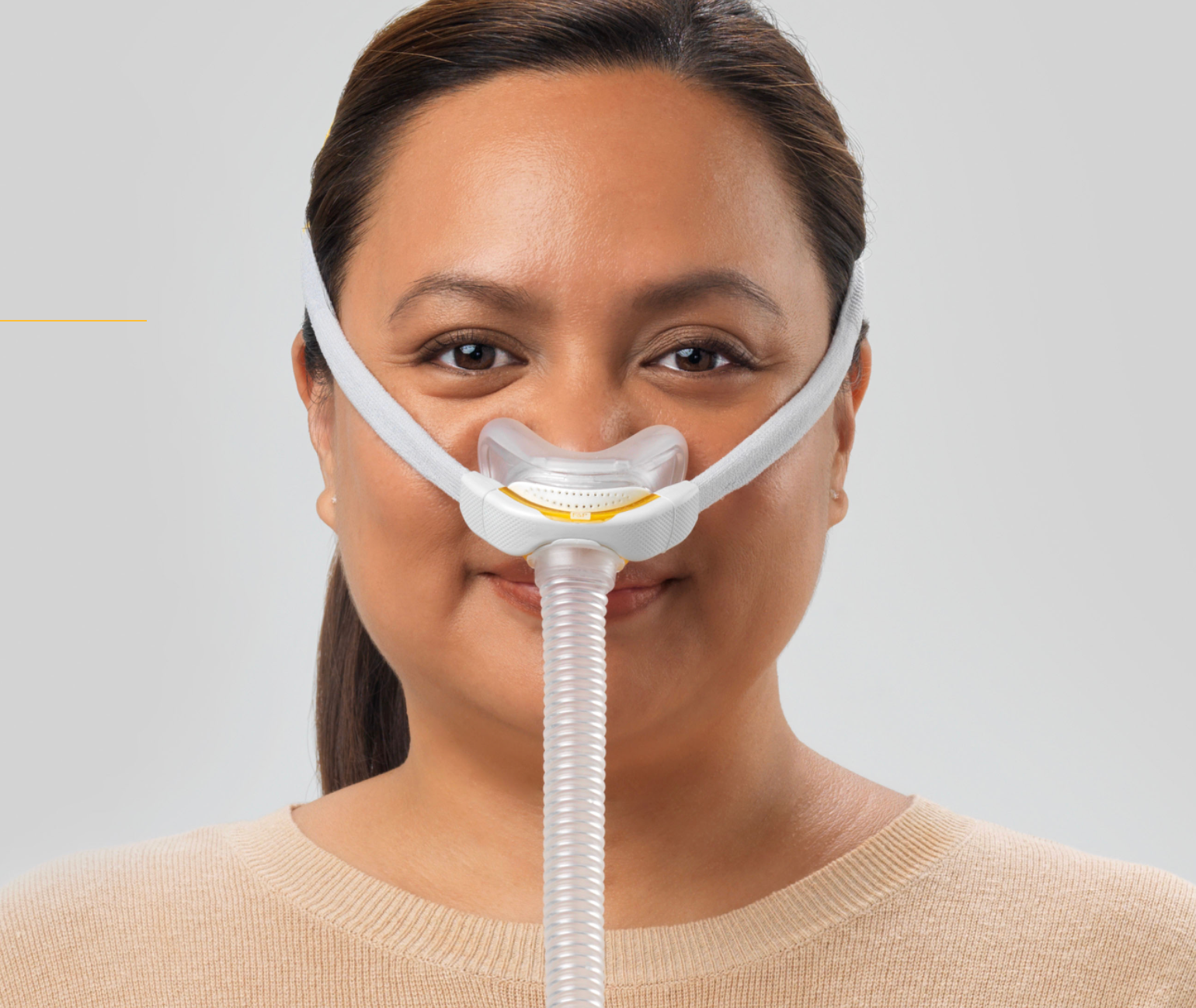
30. What is a nasal cradle mask?
A nasal cradle sits under the nose instead of using pillows that extend into the nostril openings or a cushion that surrounds the entire nose.
For example, the ResMed AirFit N30i combines an under-the-nose nasal cradle with a top-of-head hose connection.
That tube-up design can help keep the hose away from the front of the body while sleeping.
31. What is the ResMed AirTouch N30i?
The AirTouch N30i is a ResMed tube-up nasal mask with a soft fabric-wrapped frame and ResMed's ComfiSoft cushion combining fabric with silicone.
It is designed for nasal breathing and freedom of movement while sleeping.
It may be worth considering for people particularly concerned about how a mask feels against their skin.
32. What is the ResMed AirFit P10?
The AirFit P10 is a compact nasal-pillows mask.
It uses small nasal pillows rather than a cushion covering the nose or mouth.
ResMed incorporates QuietAir diffused venting, and the simple mask design has relatively few components.
USCPAP.com carries AirFit P10 masks and replacement cushions.
33. What is the ResMed AirFit P30i?
The AirFit P30i is a nasal-pillows mask with the tube connection positioned at the top of the head.
That configuration is designed to provide additional freedom when changing sleeping positions.
ResMed lists it as suitable for people who sleep in different positions, including stomach sleepers.
34. What ResMed mask is good for side sleepers?
There is no universal answer, but lower-profile masks and tube-up systems are often worth trying.
ResMed specifically identifies masks such as AirFit F40 among options for side sleepers and tube-up systems such as AirFit N30i, AirFit P30i and AirTouch N30i for people who move during sleep.
The best mask is the one that maintains an acceptable seal while remaining comfortable in your normal sleeping position.
35. What ResMed mask is good for a stomach sleeper?
A tube-up mask can be particularly useful because the hose attaches at the top of the head instead of hanging from the front of the mask.
ResMed lists the AirFit N30i, AirFit P30i and AirTouch N30i among options for people wanting freedom to sleep in different positions.
36. What ResMed mask should I consider if I have a beard?
Facial hair can make achieving a stable seal more challenging, especially with masks that seal across areas of dense facial hair.
ResMed's current mask-selection guidance identifies options including AirTouch F20, AirTouch N20, AirFit P10, AirFit N30 and AirTouch N30i as masks worth considering for users with facial hair.
Actual results depend heavily on the individual.
37. What if I feel claustrophobic in a CPAP mask?
A smaller mask may help.
Nasal pillows and under-the-nose masks reduce the amount of equipment covering the face.
Examples within ResMed's lineup include AirFit P10, AirFit N30, AirFit N30i, AirTouch N30i and the minimalist full-face AirFit F40.
Another useful strategy is wearing the mask for short periods while awake—such as while watching television—to become accustomed to it before trying to sleep.
NHLBI specifically suggests wearing the mask during part of the day when adapting to PAP therapy.
38. Why is my CPAP mask leaking?
Common causes include incorrect sizing, incorrect positioning, worn cushions, headgear that has stretched, facial oils, movement during sleep or mouth leak when using a nasal interface.
Higher leak is not automatically solved by tightening the mask.
Sometimes tightening actually deforms the cushion and makes the seal worse.
Fit the mask while lying in your normal sleeping position with therapy airflow running whenever possible.
39. Should I tighten my CPAP mask as much as possible?
No.
A CPAP mask should be secure enough to maintain its seal, but overtightening can increase pressure points, skin irritation and discomfort.
Modern cushions are designed to inflate and conform to the face.
If you repeatedly have to pull the straps extremely tight, the size, cushion condition or mask style may need to be reevaluated.
40. Why does my mask leave marks on my face?
Some temporary marks can result from normal contact, but pronounced or painful marks can indicate excessive strap tension, an inappropriate size or a mask that does not match your facial structure.
A softer or different mask design may help.
Do not ignore persistent skin breakdown, sores or significant irritation.
41. Are ResMed masks with magnets safe?
They can be used safely when the updated contraindications and warnings are followed, but this is an important safety issue.
Certain ResMed masks use magnetic headgear clips.
ResMed states that masks containing magnets are contraindicated when the user—or someone in close physical contact with the user while the mask is being worn—has certain implants or medical devices that interact with magnets or certain ferromagnetic metallic implants or objects.
ResMed instructs users to keep mask magnets at least 6 inches (150 mm) from implants or medical devices that may be adversely affected by magnetic interference.
The FDA has also issued a safety communication addressing this issue.
If you or your bed partner has an implanted device or metallic implant and you are unsure whether a magnetic mask is appropriate, consult your physician and mask provider.
42. Does ResMed make masks without magnets?
Yes.
ResMed's current mask lineup includes multiple non-magnetic choices, including several nasal and nasal-pillows designs, and ResMed also provides non-magnetic configurations for certain full-face mask users.
ResMed's mask-selection information specifically identifies non-magnetic options for people who need to avoid mask magnets.
Tell your mask provider about implanted medical devices before selecting a mask.
PART 5: GETTING USED TO CPAP
43. How many hours per night should I use CPAP?
The therapeutic goal is generally to use PAP whenever you sleep, not simply long enough to satisfy an insurance requirement.
That means the entire night and during naps whenever possible. NHLBI specifically recommends PAP use for all sleep.
Insurance compliance thresholds should not be confused with the ideal amount of treatment.
44. What is Medicare's CPAP compliance rule?
For continued Medicare coverage beyond the initial period, current CMS policy requires clinical reevaluation and objective evidence that the patient is benefiting from therapy.
CMS defines adherence as PAP use for at least four hours per night on 70% of nights during a consecutive 30-day period during the first three months of initial use.
The required clinical reevaluation must occur no sooner than day 31 and no later than day 91 after starting therapy.
Specific insurance rules vary, so always verify requirements with your insurer and equipment provider.
45. Does Medicare cover CPAP?
Medicare can cover CPAP for qualifying adults with obstructive sleep apnea when CMS diagnostic and documentation requirements are met.
CMS currently provides an initial 12-week coverage period for qualifying patients to establish that they benefit from CPAP.
Coverage criteria include a qualifying clinical evaluation and sleep test.
Medicare rules are specific and documentation matters, so individual coverage should always be verified.
46. What sleep-study numbers qualify for Medicare CPAP coverage?
Under CMS's national coverage criteria, an initial CPAP trial may qualify when the AHI or RDI is 15 or greater, or when it is 5 through 14 with certain documented symptoms or medical conditions such as excessive daytime sleepiness, impaired cognition, mood disorders, insomnia, hypertension, ischemic heart disease or history of stroke.
This is a Medicare coverage rule, not a substitute for a clinician's judgment about diagnosis or treatment.
47. What happens if I don't meet Medicare compliance?
Under current Medicare PAP coverage rules, failure to satisfy the required adherence and clinical-benefit criteria can result in denial of continued coverage beyond the initial period.
If you are struggling with therapy during the first few weeks, do not wait until the end of your compliance window.
Ask for help early.
A mask leak, dry mouth, pressure discomfort, nasal congestion or poor mask fit may be correctable.
48. How long does it take to get used to CPAP?
There is no universal timeline.
Some people notice improved sleep immediately.
Others need days or weeks to become comfortable with the mask, airflow, humidity and sensation of sleeping with equipment.
The important thing is to identify specific problems rather than concluding, "I can't use CPAP."
Most comfort complaints have identifiable causes.
49. What if I keep taking my mask off while I'm asleep?
First determine whether something is causing you to remove it.
Common possibilities include excessive pressure sensation, mask leaks, heat, dryness, rainout, nasal congestion, claustrophobia or an uncomfortable mask.
The ResMed myAir platform can help users review usage, mask seal, events per hour and mask-on/mask-off information.
If the problem persists, talk with your respiratory therapist or sleep provider.
50. If I feel better, can I stop using CPAP?
Feeling better may mean the therapy is doing what it is supposed to do.
It does not necessarily mean the underlying sleep apnea has disappeared.
Do not discontinue prescribed PAP therapy without discussing it with your healthcare provider.
51. Should I use CPAP during naps?
Yes, if PAP has been prescribed for your sleep apnea, the general recommendation is to use it whenever you sleep—including naps.
52. What happens if I miss one night?
One missed night does not mean therapy has permanently failed, but PAP only treats the airway while it is being used.
Get back to your normal therapy routine as soon as possible.
If you are repeatedly skipping treatment because of discomfort, address the reason rather than allowing nonuse to become the new routine.
PART 6: UNDERSTANDING YOUR RESMED DATA
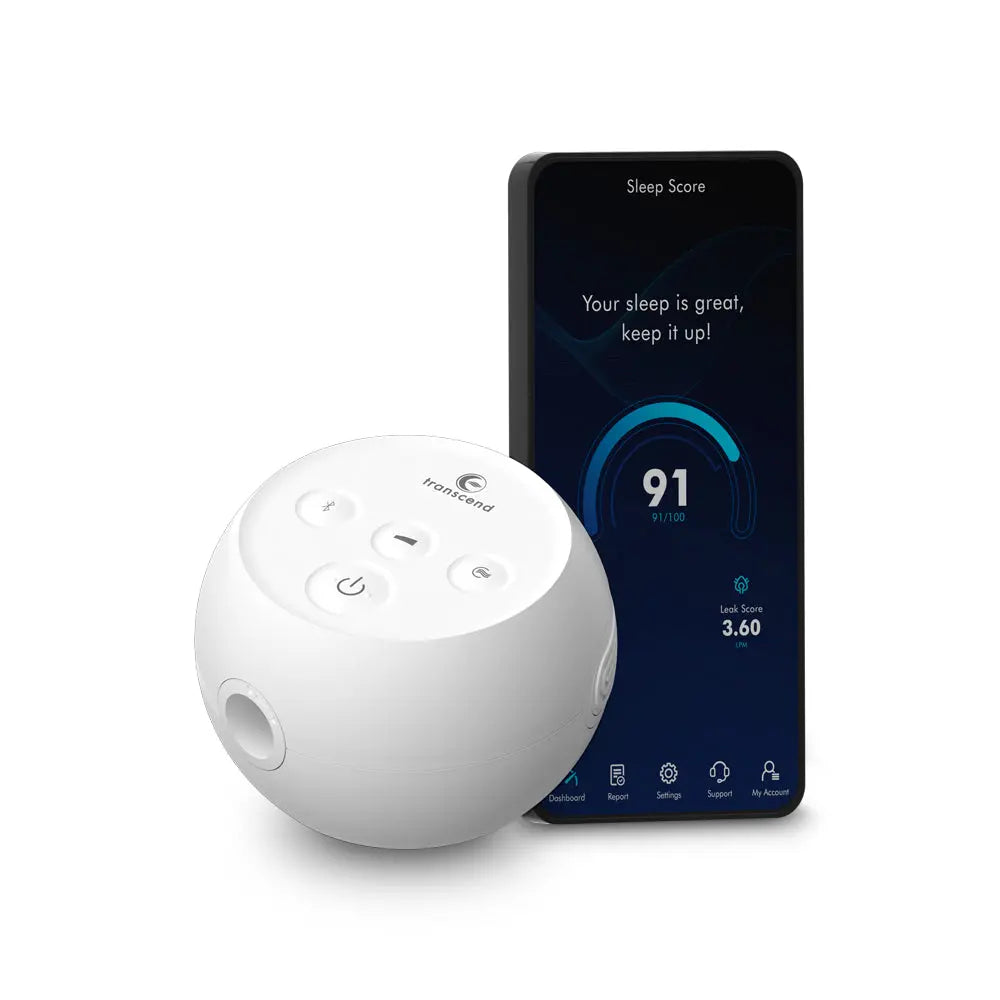
53. What is the ResMed myAir app?
myAir by ResMed is a patient-support platform that works with compatible ResMed AirSense and AirCurve machines.
It displays information including usage hours, mask seal, events per hour and mask-on/mask-off behavior.
It also provides educational and coaching tools.
54. What does myAir score measure?
The myAir score combines several aspects of nightly therapy, including how long the machine was used, mask seal, events per hour and the number of times the mask was removed.
It is useful as an engagement and troubleshooting tool, but it does not replace interpretation by your sleep physician.
55. What does "events per hour" mean on my ResMed machine?
It is an estimate of the number of apnea and hypopnea breathing events occurring per hour while the machine is being used.
If the number consistently appears higher than expected, contact your sleep clinician rather than attempting major pressure changes yourself.
56. Is a good myAir score the same as a perfect sleep study?
No.
myAir is designed to help track PAP usage and treatment-related information.
It is not equivalent to a full diagnostic polysomnogram and does not measure everything that a sleep laboratory measures.
Use the information as a tool for monitoring therapy—not as a replacement for your physician.
PART 7: CLEANING YOUR RESMED CPAP EQUIPMENT
57. How often should I clean my ResMed CPAP mask?
ResMed currently recommends cleaning many mask cushions daily and cleaning the frame and headgear weekly, while following the specific instructions for the particular mask.
Different materials can require different care.
For example, certain AirTouch memory-foam components have different cleaning instructions than standard silicone cushions.
Always follow the instructions supplied with your exact mask.
58. How often should I clean my CPAP tubing?
ResMed recommends regular cleaning of compatible air tubing, commonly on a weekly basis.
Use the cleaning method specified in the product instructions and allow tubing to dry away from direct sunlight and excessive heat.
59. How should I clean my humidifier chamber?
ResMed's current cleaning instructions call for regularly emptying and drying the humidifier tub and performing routine washing according to the equipment's user guide.
ResMed provides specific instructions for weekly cleaning of the tub using appropriate mild cleaning methods.
Inspect the chamber regularly for discoloration, deposits or damage.
60. Should I use ozone to clean my ResMed machine?
ResMed's instructions emphasize traditional cleaning with appropriate mild cleaning products and water.
ResMed states that repeated ozone exposure can eventually cause internal machine damage and that ozone-related damage is excluded from its limited warranty.
The FDA has also cautioned consumers regarding devices marketed to clean CPAP equipment using ozone or UV and emphasizes that add-on devices do not replace manufacturer-recommended cleaning.
Follow ResMed's cleaning instructions for your equipment.
61. Can I use bleach, alcohol or essential oils to clean my mask?
ResMed advises against a variety of strong or inappropriate cleaning products because they can damage equipment or leave undesirable residues.
Its current guidance advises users to avoid products such as bleach, alcohol, aromatic or scented oils and strong-smelling cleaning agents.
Follow the instructions for the exact mask or component you own.
62. How often should CPAP supplies be replaced?
There is no one replacement date for every component or every insurance plan.
ResMed provides general replacement guidance, while insurance reimbursement schedules can vary.
As a general manufacturer guideline, ResMed discusses replacement intervals for components such as cushions, filters, mask frames, tubing, headgear and humidifier tubs.
Equipment should also be replaced when wear affects fit, hygiene or performance.
63. Why do CPAP cushions eventually start leaking?
Mask cushions are flexible materials exposed every night to facial oils, skin products, movement and repeated cleaning.
Over time they can soften, lose their original shape or seal less effectively.
If a mask that previously sealed well suddenly requires excessive tightening, inspect the cushion and headgear for wear before assuming your pressure is the problem.
PART 8: TRAVELING WITH CPAP
64. Should I take CPAP with me when I travel?
Yes.
Sleep apnea does not take a vacation because you do.
NHLBI recommends bringing PAP equipment when traveling and using it whenever you sleep.
Frequent travelers may find the ResMed AirMini particularly convenient because of its compact size.
65. Is ResMed AirMini good for frequent travelers?
That is exactly the type of use AirMini was designed to address.
It weighs less than a pound, fits easily into travel luggage and provides ResMed AutoSet therapy in a very small package.
Its HumidX system can provide waterless humidification with compatible ResMed configurations.
For someone who flies frequently or wants to reduce luggage bulk, AirMini can be especially attractive.
66. Can I use CPAP on an airplane?
Many PAP devices are designed to support travel, but you should verify the specific device documentation and the airline's requirements before flying.
If you plan to operate the device during flight, contact the airline beforehand, particularly if you need onboard power or a battery.
Battery rules matter as well. FAA guidance places specific watt-hour restrictions on rechargeable lithium batteries and requires spare lithium batteries to be carried in carry-on baggage rather than checked baggage.
67. Should I pack my CPAP in checked luggage?
For something you depend on every night, keeping the machine with you whenever practical reduces the risk of arriving at your destination without therapy because checked luggage was delayed or lost.
Protect the machine in its travel case and keep important accessories together.
68. What should I bring when traveling with CPAP?
Think beyond the machine itself.
Bring the correct power supply, tubing, mask, cushion, headgear and any required AirMini setup components or HumidX cartridges.
For longer trips, carrying a spare cushion or other small high-wear component can prevent a minor equipment problem from disrupting therapy.
PART 9: POWER OUTAGES AND EMERGENCIES
69. What happens to CPAP during a power outage?
Standard home PAP equipment requires electrical power.
If outages are common where you live, discuss an appropriate backup-power strategy in advance.
Never assume a generic battery system is compatible with your ResMed device.
Verify voltage, connector, capacity and manufacturer requirements before use.
70. Can I run my CPAP from a battery?
Depending on the particular ResMed device and approved power configuration, battery operation may be possible.
Runtime varies dramatically according to battery capacity and power consumption, particularly when heated humidification or heated tubing is involved.
Use equipment appropriate for the specific machine and plan before an emergency occurs.
PART 10: BUYING CPAP EQUIPMENT
71. Do I need a prescription to buy a ResMed CPAP machine?
A valid prescription is required for prescription PAP equipment.
USCPAP.com's current ResMed AirSense 11 and AirSense 10 product information identifies the prescription requirement for these machines.
If you already have a prescription, USCPAP.com provides options for submitting it with your order.
72. Why does buying from an authorized ResMed dealer matter?
USCPAP.com states that it has been an authorized ResMed dealer for more than 10 years and purchases its ResMed products directly through ResMed.
That gives customers confidence regarding product authenticity, traceability and applicable manufacturer warranty support.
This is particularly important with medical equipment that you may depend on every night.
73. What is ResMed's warranty on CPAP machines?
ResMed's current U.S. limited-warranty information provides a two-year warranty period for CPAP and bilevel devices, including their external power supplies, subject to warranty terms and exclusions.
Warranty periods differ for masks, accessories, tubing, water chambers and other components.
74. Does improper cleaning affect the ResMed warranty?
It can.
ResMed's warranty excludes certain types of damage caused by misuse and specifically excludes damage caused by ozone, activated oxygen or other gases.
That is another reason to follow ResMed's cleaning instructions rather than experimenting with aggressive cleaning methods.
75. Can I use HSA or FSA funds for CPAP supplies?
USCPAP.com identifies HSA/FSA payment as available for qualifying CPAP equipment and supplies.
Individual eligibility and reimbursement depend on your plan, so verify requirements when necessary.
76. Can I buy CPAP supplies locally instead of ordering online?
Yes.
USCPAP.com is part of USA Medical Supply, which has a retail location at:
1779 Riverdale Street
West Springfield, MA 01089
The location offers CPAP products and access to licensed respiratory therapists.
Current posted walk-in hours are Monday through Friday, 9 AM–6 PM, and Saturday, 9 AM–2 PM.
77. Can I talk to a respiratory therapist about my CPAP?
Yes.
USA Medical Supply states that licensed respiratory therapists are available to assist CPAP users at the West Springfield location.
That can be particularly useful when a problem involves mask fitting, comfort, equipment operation or understanding therapy data.
Clinical issues and prescription changes should also involve your treating healthcare provider as appropriate.
78. Can I try different ResMed masks?
For many users, finding the correct mask is the most important part of making CPAP sustainable.
A mask that looks good online may feel completely different once it is on your face under therapy pressure.
USCPAP.com's local support gives customers an opportunity to receive help understanding the differences between ResMed full-face, nasal, nasal-cradle and nasal-pillows designs.
79. Which ResMed CPAP setup is best for a new user?
There is no single answer for everyone, but a common starting discussion might include:
A ResMed AirSense 11 AutoSet for home therapy, combined with the ResMed mask style that best matches the patient's breathing pattern, sleeping position and facial anatomy.
Someone who travels frequently might also consider AirMini.
Someone prescribed bilevel therapy may instead require a device such as AirCurve 11 VAuto.
The prescription comes first. The equipment should be selected around the therapy that has actually been ordered.
80. What's the biggest mistake people make when starting CPAP?
Waiting too long to ask for help.
A person may struggle for weeks with a leaking mask, dry mouth, pressure discomfort or incorrect fit and eventually decide that "CPAP doesn't work for me."
Often the real problem is much more specific.
The mask may be wrong.
The cushion may be the wrong size.
Humidity may need attention.
The patient may need help understanding ramp or comfort features.
The equipment may be worn.
Or the clinician may need to review therapy data.
Successful CPAP treatment is not simply about owning a machine. It is about making the entire system work for the person using it.
THE RESMED PRODUCTS WE FOCUS ON AT USCPAP.COM
This guide intentionally discusses ResMed products exclusively.
For home PAP therapy, that includes the ResMed AirSense 11 AutoSet and AirSense 10 AutoSet.
For travel, it includes the ResMed AirMini.
For patients prescribed appropriate bilevel therapy, it includes the ResMed AirCurve 11 VAuto.
For masks, relevant ResMed families include AirFit and AirTouch, with choices such as AirFit F40, AirFit F20, AirFit N30i, AirFit P10, AirFit P30i and AirTouch N30i.
Accessories include ResMed HumidAir water tubs, ClimateLineAir heated tubing, filters, replacement cushions, headgear and compatible AirMini HumidX products.
Product availability and specifications can change, so verify current compatibility before ordering.
FINAL THOUGHTS: CPAP SHOULD BE PERSONAL
There is a temptation to think of CPAP as simply:
Machine + hose + mask.
Successful therapy is more personal than that.
Two people can have the same diagnosis and need very different masks.
Two people can use the same AirSense 11 and prefer completely different humidity settings.
One person may love nasal pillows.
Another may need a full-face mask.
One person travels every week and wants an AirMini.
Another rarely leaves home and values a traditional bedside setup.
That is why support matters.
If something about your CPAP therapy isn't working, the answer should not automatically be to give up.
Ask why.
Is the mask leaking?
Is your mouth dry?
Are you removing your mask?
Does the pressure feel uncomfortable?
Are you experiencing rainout?
Is the cushion worn?
Are you worried about Medicare compliance?
Do you need a different ResMed mask style?
The sooner you identify the actual problem, the sooner you can work toward making therapy more comfortable and sustainable.
Need Help With ResMed CPAP Equipment?
USCPAP.com / USA Medical Supply
1779 Riverdale Street
West Springfield, MA 01089
Call: 413-733-7843
Text: 413-200-4191
USCPAP.com is an authorized ResMed dealer, and licensed respiratory therapists are available through the West Springfield location to help with CPAP equipment and supply questions.
Better CPAP therapy doesn't start with simply buying more equipment. It starts with understanding what you need and why.
Bibliography & Sources
USCPAP.com. The Ultimate Guide to CPAP and Sleep Apnea: Your Questions Answered. February 8, 2025. Original USCPAP.com FAQ used as the foundation for this substantially expanded 2026 edition.
USCPAP.com. Helpful Resources. Information regarding the West Springfield retail location, licensed respiratory therapists and authorized ResMed dealer status.
USCPAP.com. ResMed AirSense 11 AutoSet CPAP Machine with Built-In HumidAir Humidifier. Current product information.
USCPAP.com. ResMed AirSense 10 AutoSet with HumidAir — Card to Cloud. Current product information.
USCPAP.com. ResMed AirMini AutoSet Travel CPAP Machine. Current AirMini product information.
USCPAP.com. ResMed AirCurve 11 VAuto BiLevel Machine. Current product information.
USCPAP.com. ResMed ClimateLineAir Heated Tubing for AirSense 11 and AirCurve 11. Heated tubing and climate-control information.
ResMed. AirSense 11. Current manufacturer overview of AirSense 11 AutoSet/CPAP therapy, myAir, Personal Therapy Assistant and Care Check-In.
ResMed. AirSense 10 Series. Manufacturer information regarding AirSense 10, AutoSet, HumidAir, AutoRamp and EPR.
ResMed. AirMini Portable CPAP. Manufacturer information regarding AirMini therapy modes, portability, HumidX and compatible ResMed mask systems.
ResMed. AirCurve 11 Bilevel / AirCurve 11 VAuto. Manufacturer information regarding bilevel pressure support and VAuto therapy.
ResMed. CPAP Masks. Current ResMed mask-selection guidance for sleeping position, facial hair, mouth breathing, skin sensitivity, noise and non-magnetic options.
ResMed. AirFit F40. Manufacturer information regarding ResMed's minimalist under-the-nose full-face mask and AdaptiSeal cushion.
ResMed. AirFit F20. Manufacturer information regarding full-face coverage, InfinitySeal technology and magnetic-clip warnings.
ResMed. AirFit N30i. Manufacturer information regarding nasal-cradle design and top-of-head tubing.
ResMed. AirFit P30i. Manufacturer information regarding tube-up nasal-pillows design and QuietAir venting.
ResMed. AirTouch N30i. Manufacturer information regarding ComfiSoft fabric cushion, fabric-wrapped frame and tube-up configuration.
ResMed. CPAP Humidification and Tubing. Manufacturer information regarding HumidAir 11, ClimateLineAir 11 and HumidX waterless humidification.
ResMed. How to Clean Your CPAP Equipment. Manufacturer cleaning guidance for masks, tubing and humidifier chambers.
ResMed. Updated Information on Masks with Magnets. Current contraindications and six-inch separation warning for magnetic mask components and susceptible medical implants/devices.
ResMed. Product Warranty Information. Current warranty durations and exclusions, including ozone-related damage.
ResMed. myAir. Information regarding usage hours, mask seal, events per hour and mask-on/mask-off data.
National Heart, Lung, and Blood Institute, National Institutes of Health. Sleep Apnea. Current overview of obstructive and central sleep apnea and potential health consequences.
National Heart, Lung, and Blood Institute. Sleep Apnea Symptoms. Common symptoms including snoring, interrupted breathing, gasping and daytime sleepiness.
National Heart, Lung, and Blood Institute. Sleep Apnea Diagnosis. Guidance regarding sleep studies and clinical diagnosis.
National Heart, Lung, and Blood Institute. CPAP. Overview of continuous positive airway pressure therapy, benefits, equipment and recommended use.
Centers for Medicare & Medicaid Services. National Coverage Determination 240.4 — Continuous Positive Airway Pressure Therapy for Obstructive Sleep Apnea. Medicare diagnostic and initial-coverage requirements.
Centers for Medicare & Medicaid Services. LCD L33718 — Positive Airway Pressure Devices for the Treatment of Obstructive Sleep Apnea. Current continued-coverage and adherence requirements, including the four-hour/70% standard.
U.S. Food and Drug Administration. Certain ResMed Masks for BiPAP/CPAP Machines Recalled Due to Safety Issue with Magnets That May Affect Certain Medical Devices. FDA safety communication regarding magnetic mask components.
U.S. Food and Drug Administration. Do You Need a Device That Claims to Clean a CPAP Machine? FDA information regarding ozone, UV and add-on CPAP cleaning devices.
Federal Aviation Administration. Airline Passengers and Batteries. Current guidance concerning rechargeable and spare lithium batteries during air travel.





Leave a comment
This site is protected by hCaptcha and the hCaptcha Privacy Policy and Terms of Service apply.