
Article: ResMed AirFit CPAP Masks: The Ultimate 2026 Guide to Every Model, Features, Fit & Comparison
ResMed AirFit CPAP Masks: The Ultimate 2026 Guide to Every Model, Features, Fit & Comparison
The Ultimate ResMed AirFit CPAP Mask Guide for 2026: Every Model Compared, From P10 and N30 to F40 and X30i
Introduction: There Is More to ResMed AirFit Than the P10, N20, and F20
If you have been using CPAP therapy for several years, you may already recognize the ResMed AirFit P10 nasal pillows mask, N20 nasal mask, and F20 full-face mask.
These established products continue to serve important roles in sleep apnea therapy.
But ResMed's AirFit family has grown well beyond those three familiar options.
Today's lineup includes nasal cradle masks that rest gently beneath the nose, top-of-head tubing designs created for people who frequently change sleeping positions, ultra-compact full-face masks that avoid the nasal bridge, and even an oral-nasal hybrid combining nasal pillows with a separate mouth cushion.
Understanding these differences is important.
Someone who dislikes a conventional full-face mask may find an under-the-nose model more comfortable. A person frustrated by tubing across the chest may appreciate a top-of-head connection. A patient who experiences nasal-pillow soreness may prefer a nasal cradle cushion.
And someone who regularly experiences mouth leakage with a nasal mask may benefit from considering a different interface altogether.
At USCPAP.com, a division of USA Medical Supply, we believe patients deserve clear, accurate information about their treatment equipment.
This guide examines every core ResMed AirFit mask currently featured in the manufacturer's U.S. lineup, explains the differences between the models, and addresses the questions customers should ask before purchasing.
Our goal is simple: help you understand your options so you can select a mask that supports comfortable, effective, consistent CPAP therapy.
1. Understanding the ResMed AirFit Naming System
Before comparing individual masks, it helps to understand what their names mean.
ResMed organizes its products into different families based on cushion materials and design.
What does AirFit mean?
ResMed's AirFit masks use silicone cushions.
Silicone can provide flexibility, conform to facial contours, and create an appropriate seal when the mask is correctly sized and positioned.
The AirFit family includes several distinct interface categories.
P: Nasal pillows masks
The letter P identifies nasal pillows.
These masks use small silicone pillows that seal at the nostril openings.
Examples:
-
AirFit P10
-
AirFit P30i
Nasal pillows minimize contact with the nose and surrounding facial skin.
N: Nasal masks
The letter N identifies nasal interfaces.
Within this category, the cushion may surround the nose or rest beneath it.
Examples:
-
AirFit N20
-
AirFit N30
-
AirFit N30i
The N20 uses a conventional over-the-nose cushion.
The N30 and N30i use nasal cradle cushions beneath the nose.
F: Full-face masks
The letter F identifies full-face masks.
These interfaces support breathing through the mouth and nose.
Examples:
-
AirFit F20
-
AirFit F30i
-
AirFit F40
Not all full-face cushions cover the bridge of the nose.
The F30i and F40 use under-the-nose designs, while the F20 surrounds both the nose and mouth.
X: Oral-nasal masks
The X identifies ResMed's oral-nasal design.
The AirFit X30i combines nasal pillows with a separate oral cushion.
It provides mouth and nose coverage through a different sealing arrangement than a conventional full-face mask.
What does the letter i mean?
In the current AirFit naming system, an i suffix identifies a tube-up design in which the main air hose attaches at the top of the head.
Examples include:
-
P30i
-
N30i
-
F30i
-
X30i
This arrangement is intended to keep the hose away from the front of the face and chest.
It may be particularly appealing to people who turn frequently during sleep.
2. Complete ResMed AirFit Mask Comparison Chart
The following table summarizes the nine core models in ResMed's current U.S. AirFit product lineup.
| Model | Mask type | Tube connection | Principal distinction |
|---|---|---|---|
| AirFit P10 | Nasal pillows | Front | Lightweight, minimalist nasal-pillow design |
| AirFit P30i | Nasal pillows | Top of head | Nasal pillows with freedom of movement |
| AirFit N20 | Traditional nasal | Front | InfinitySeal cushion surrounding nose |
| AirFit N30 | Nasal cradle | Front | Minimalist, under-the-nose nasal seal |
| AirFit N30i | Nasal cradle | Top of head | Under-the-nose seal with tube-up frame |
| AirFit F20 | Traditional full face | Front | InfinitySeal cushion over nose and mouth |
| AirFit F30i | Compact full face | Top of head | Under-the-nose full-face design |
| AirFit F40 | Compact full face | Front | Flexible AdaptiSeal silicone cushion |
| AirFit X30i | Oral nasal | Top of head | Separate oral and nasal-pillows sealing surfaces |
Each model has its own advantages, limitations, available sizes, replacement components, and safety instructions.
The current lineup should not be interpreted as a ranking from worst to best.
A newer mask is not automatically the right choice for someone already using an older model successfully.
PART ONE: RESMED AIRFIT NASAL PILLOWS MASKS
3. ResMed AirFit P10: The Lightweight Minimalist
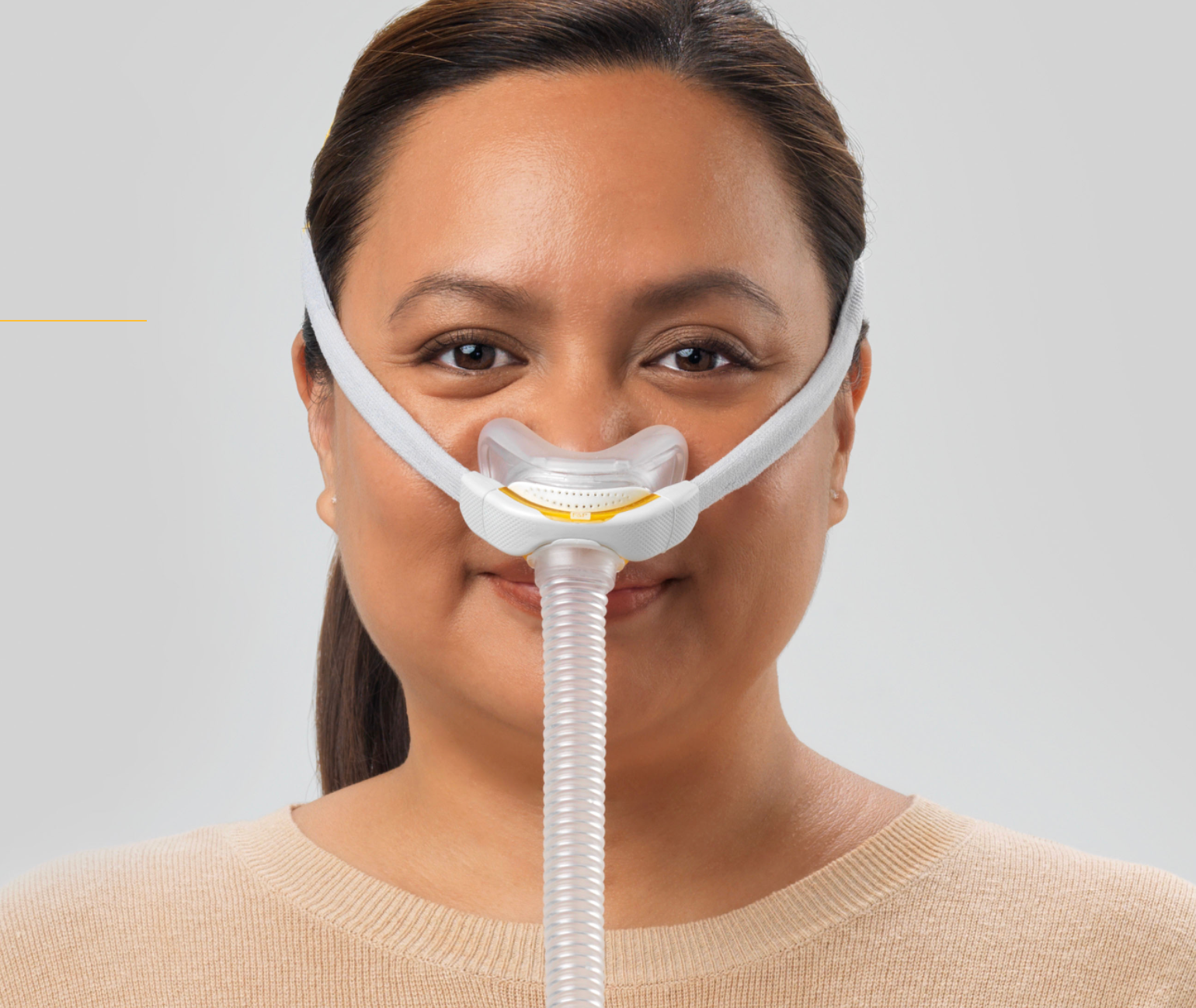
The AirFit P10 is among ResMed's best-known minimalist CPAP masks.
Rather than sealing around the bridge and sides of the nose, the P10 uses two soft silicone nasal pillows.
This substantially reduces the amount of material contacting the face.
Main features
Minimal facial coverage
Only the nasal pillows and headgear make significant contact.
The forehead, cheeks, and nasal bridge remain largely unobstructed.
QuickFit headgear
The P10 uses simple, elastic split-band headgear designed to make fitting and removal straightforward.
QuietAir ventilation
Its woven-mesh vent is designed to disperse exhaled airflow quietly.
Front tube connection
The air supply enters the mask from the front through a short flexible tube.
Multiple pillow sizes
Different nasal-pillow sizes allow patients to select a fit appropriate for their nostrils.
Why patients choose the P10
Some people dislike the feeling of a substantial mask covering their face.
Others want to read, wear glasses, or watch television before sleeping.
The P10's compact design can appeal to those preferences.
It may also be worth considering for people who have difficulty maintaining a seal over facial hair around the upper lip or cheeks, depending on their individual anatomy.
Potential limitations
Nasal pillows can cause discomfort if incorrectly sized or positioned.
Some users experience irritation at the nostril openings.
The front-facing tube may also be less convenient for people who regularly turn from side to side.
And because the P10 does not cover the mouth, significant mouth leakage can interfere with therapy.
Our assessment
The AirFit P10 remains a practical option for patients who breathe comfortably through their noses and prefer a simple, low-profile mask.
Its greatest strength is its minimalist design—not a claim that it is automatically more effective than larger interfaces.
4. ResMed AirFit P30i: Nasal Pillows With Top-of-Head Tubing
The AirFit P30i offers a different approach to nasal-pillows therapy.
It combines nasal pillows with a tube-up frame.
Instead of connecting the main hose in front of the nose, the P30i routes airflow through a hollow frame and connects the tubing at the top of the head.
Key features
Top-of-head air connection
The hose connects above the head, helping keep tubing away from the user's chest.
Hollow frame technology
Air travels through the frame to reach the nasal pillows.
QuietAir venting
The mask incorporates diffused exhalation technology intended to reduce noise and airflow disturbance.
Quick-release elbow
The upper connection allows the user to disconnect from the tubing without completely removing the mask.
Interchangeable cushion design
ResMed designed the P30i and N30i mask platforms to accept compatible P30i nasal pillows and N30i nasal cradle cushions.
This provides an important option for patients considering a change between the two nasal interfaces.
Who may prefer the P30i?
Patients who enjoy nasal pillows but dislike front-mounted tubing may find this design appealing.
The P30i can also be worth evaluating for people who frequently change positions while sleeping.
Possible disadvantages
The hollow frame rests along portions of the face and head.
Some users may feel this is more noticeable than the P10's minimalist headgear.
A side sleeper may press one side of the frame against a pillow, although the system is designed to continue delivering air through its frame arrangement.
The P30i also has more components to inspect and clean than the P10.
P10 versus P30i
Choose between these two based primarily on the desired headgear and hose arrangement.
The P10 emphasizes simplicity and minimal contact.
The P30i emphasizes movement and keeping the primary hose away from the face.
Neither is universally superior for nasal-pillow therapy.
PART TWO: RESMED AIRFIT NASAL MASKS
5. ResMed AirFit N20: The Traditional Nasal Option
The AirFit N20 provides more nasal coverage than the P10, N30, or N30i.
It uses ResMed's InfinitySeal silicone cushion to surround the nose.
The cushion has varying thicknesses and structural features designed to adapt to different facial profiles.
Main features
InfinitySeal silicone cushion
The N20 is designed to provide a stable seal around the nose.
ResMed reports a 99% fit range in its international fitting study.
This represents the results of the manufacturer's study, not a guarantee of comfort or perfect sealing for every individual.
Flexible frame
The frame follows the face below the eyes.
Plush headgear
Adjustable straps help position and stabilize the cushion.
Quick-release elbow
Users can disconnect the therapy hose without fully removing the headgear.
Magnetic headgear clips
The standard N20 uses magnetic attachments.
These are subject to important contraindications for certain medical implants and devices.
Who might prefer the N20?
The N20 is a useful option for patients who:
-
Breathe primarily through the nose.
-
Dislike nasal pillows touching the nostrils.
-
Prefer a conventional nasal cushion.
-
Want an adjustable headgear system.
-
Appreciate a quick-release connection.
What are its limitations?
The N20 contacts the bridge and sides of the nose.
Incorrect sizing or excessive strap tension can contribute to pressure marks or leakage.
Like other nasal-only masks, it may not adequately accommodate significant mouth leakage.
And the magnetic components make pre-purchase safety screening essential.
Our assessment
The N20 remains a strong conventional nasal-mask option, particularly for patients who find under-the-nose cushions or nasal pillows uncomfortable.
6. ResMed AirFit N30: Minimalist Nasal Cradle Comfort
The AirFit N30 introduces a different way to deliver nasal CPAP therapy.
Instead of placing pillows at the nostril openings or surrounding the nose, it uses a curved silicone cradle that rests beneath the nose.
The cushion seals around the underside of the nostrils.
What makes the N30 different?
Under-the-nose cushion
The nasal cradle avoids direct contact with the nasal bridge.
Minimalist headgear
Its slip-on QuickFit headgear helps simplify nightly use.
Lightweight design
ResMed markets the N30 among its lightest and most discreet masks.
Front tube connection
The N30 uses a tube-down configuration.
QuietAir vent technology
The diffuser is intended to reduce noise and the force of exhaled airflow.
N30 versus P10: Why the distinction matters
Both masks are small and lightweight, but their cushions are different.
The P10 uses nasal pillows.
The N30 uses a nasal cradle.
This difference can be important for people who feel discomfort directly around their nostril openings.
A patient who likes the P10's lightweight construction but dislikes nasal pillows may find the N30 worth considering.
Potential limitations
The nasal cradle must align correctly beneath the nostrils.
A poorly sized cushion can leak or shift during movement.
Some users may prefer the more defined positioning of nasal pillows.
And the front-mounted hose may still feel inconvenient for active sleepers.
Our assessment
The N30 is a particularly useful addition to ResMed's portfolio because it gives customers a minimalist nasal option without conventional nasal pillows.
For many shoppers, the decision between the P10 and N30 is less about which mask is more advanced and more about which cushion design feels better.
7. ResMed AirFit N30i: Nasal Cradle With Tube-Up Freedom
The AirFit N30i combines a curved nasal cradle cushion with a top-of-head hose connection.
It is designed for patients who want under-the-nose comfort while keeping the main tubing away from the front of the face.
Key features
Top-of-head connection
The tubing connects above the head rather than in front of the nose.
Curved nasal cradle
The silicone cushion rests beneath the nostrils.
SpringFit frame
ResMed's flexible frame is designed to accommodate different head shapes.
QuietAir technology
Diffused venting helps manage exhalation airflow and sound.
Compatible nasal cushion platform
ResMed supports switching between appropriate N30i cradle cushions and P30i nasal pillows on the compatible mask platform.
Who may benefit from considering the N30i?
It is worth evaluating for patients who:
-
Change sleeping positions frequently.
-
Prefer an under-the-nose cushion.
-
Dislike tubing in front of their faces.
-
Wear glasses before bed.
-
Want a nasal interface that does not cover the nasal bridge.
N30 versus N30i
These names are similar, but the products are not identical.
| Feature | AirFit N30 | AirFit N30i |
|---|---|---|
| Nasal cradle | Yes | Yes |
| Tubing position | Front | Top of head |
| Headgear design | Minimalist split-band | Hollow-frame system |
| Main priority | Simplicity | Freedom of movement |
| P30i cushion interchangeability | No general interchangeability claim | Compatible system |
A shopper should not order an N30 replacement cushion assuming it fits the N30i.
The complete product name matters.
PART THREE: RESMED AIRFIT FULL-FACE AND ORAL-NASAL MASKS
8. ResMed AirFit F20: Traditional Full-Face Coverage
The AirFit F20 is a traditional full-face mask covering the nose and mouth.
Unlike the F30i and F40, its cushion extends over the nasal bridge.
Major features
InfinitySeal cushion
ResMed's silicone cushion is designed to provide a flexible seal across different facial contours and prescribed therapy pressures.
Conventional full-face coverage
The mask surrounds the mouth and nose in a single cushion.
Adjustable headgear
The headgear supports a stable fit.
QuietAir elbow
Compatible QuietAir elbow configurations diffuse exhaled airflow.
Quick-release connection
The elbow can be disconnected without removing the complete mask.
Magnetic clips
The standard F20 uses magnetic headgear attachments.
Why the F20 remains important
Not every patient wants an under-the-nose full-face mask.
Some prefer a conventional cushion surrounding the nose.
Others may achieve a more reliable seal with the F20 than with an ultra-compact alternative.
The F20 also offers an established ecosystem of replacement cushions, headgear, and frames.
Potential limitations
The cushion contacts the nasal bridge.
This may be uncomfortable for people prone to pressure marks.
Its larger facial footprint may also feel restrictive to someone who prefers a minimalist interface.
Is the F20 suitable for high therapy pressures?
ResMed specifically designed the F20 for reliable performance across a wide range of therapy pressures.
However, it is incorrect to suggest that every patient using higher pressures requires a full-face mask.
A correctly fitted nasal or nasal-pillows interface may also work effectively within the manufacturer's stated limits.
Selection depends on the individual.
The non-magnetic F20
ResMed also identifies an AirFit F20 Non Magnetic configuration.
This is an important alternative for patients whose medical circumstances make magnetic clips inappropriate.
Patients should verify that they are purchasing the actual non-magnetic version rather than the standard F20.
9. ResMed AirFit F30i: Compact Full-Face Coverage With Tube-Up Design
The AirFit F30i combines two features that were historically difficult to find together:
Full-face airflow delivery and a top-of-head tubing connection.
Its UltraCompact cushion rests beneath the nose while surrounding the mouth.
The cushion avoids the bridge of the nose, leaving much of the upper face unobstructed.
What makes the F30i distinctive?
Under-the-nose full-face cushion
The F30i provides mouth and nose therapy without covering the nasal bridge.
Top-of-head tubing
The hose connects above the head.
Hollow frame
Air travels through the frame to the cushion.
Quick-release elbow
Users can disconnect the main tube for short breaks.
Magnetic clips
The standard F30i uses magnetic headgear attachments.
Who may prefer the F30i?
Patients who experience mouth leakage with nasal masks may want to investigate a full-face interface.
Among those patients, the F30i may appeal especially to people who:
-
Frequently sleep on their sides.
-
Change positions repeatedly.
-
Dislike tubing resting across the chest.
-
Want the nasal bridge unobstructed.
-
Prefer a low-profile mask for reading or watching television.
What should customers consider before purchasing?
The F30i's seal depends on correct contact beneath the nose and around the mouth.
This design does not automatically fit everyone more effectively than a traditional full-face mask.
The hollow frame also adds contact points along the cheeks or sides of the face.
And the complete mask has more components than a minimalist nasal interface.
Magnetic and non-magnetic options
ResMed identifies an AirFit F30i Non Magnetic configuration among its available non-magnetic masks.
Customers with applicable implant contraindications should specifically verify the exact non-magnetic model and compatible components.
10. ResMed AirFit F40: UltraCompact Full-Face Innovation
The AirFit F40 is one of the most important models to understand when comparing ResMed's newer mask designs.
It combines full-face therapy with a very compact cushion and a front-mounted tube.
ResMed describes the F40 as its smallest tube-down full-face mask, based on the manufacturer's referenced research.
The AdaptiSeal cushion
The F40's defining feature is its AdaptiSeal silicone cushion.
Unlike more rigid mask arrangements, the cushion is designed to be especially flexible.
It rests beneath the nose while sealing around the mouth.
Its construction helps accommodate facial movement during sleep.
What makes the F40 different?
Minimal facial coverage
The cushion does not extend across the bridge of the nose.
Flexible silicone design
The AdaptiSeal cushion is designed to adapt to facial contours.
Front tube connection
Unlike the F30i, the F40 uses a tube-down design.
Magnetic headgear clips
These simplify attachment but require screening for medical-device contraindications.
Multiple fitting combinations
The F40 offers three cushion sizes and three headgear sizes.
The cushion sizes are Small Wide, Medium, and Large.
Manufacturer-reported fitting results
ResMed reports a 98% fit range in an external clinical study.
The manufacturer also reports that surveyed patients rated the mask positively for ease of fitting and comfort.
These results are specific to the manufacturer's cited study population and testing methods.
They should not be interpreted as a guarantee that the F40 will fit every customer or outperform every competing mask.
F40 versus F20
The main difference is the cushion architecture.
The F20 surrounds the bridge of the nose and mouth.
The F40 rests beneath the nose and around the mouth, leaving the nasal bridge uncovered.
The F20 has a more traditional full-face structure.
The F40 emphasizes a low-profile, flexible cushion.
Both can deliver full-face therapy when properly fitted.
F40 versus F30i
This comparison is especially important.
Both masks provide under-the-nose full-face coverage.
But the F40 uses a front-mounted tube, while the F30i connects at the top of the head.
The F40 also uses the flexible AdaptiSeal cushion.
The F30i uses a different UltraCompact cushion and hollow-frame arrangement.
The most important decision between the F40 and F30i is often whether the patient prefers a tube-down minimalist design or a tube-up system that keeps the main hose overhead.
Our assessment
The F40 is an important option for patients who want full-face coverage without the traditional larger cushion.
Its compact design makes it especially relevant to patients considering an alternative to the F20.
However, the best mask remains the one that fits securely and comfortably in actual use.
11. ResMed AirFit X30i: The Oral-Nasal Hybrid
The AirFit X30i takes a different approach from the other AirFit masks.
ResMed categorizes it as an oral-nasal mask.
It combines nasal pillows with a separate oral cushion.
This allows pressurized airflow through the mouth and nose while using nasal pillows to create an additional nasal seal.
Why is the X30i different?
Most full-face masks use one main cushion arrangement covering the nose and mouth.
The X30i instead incorporates distinct oral and nasal sealing components.
The nasal pillows stabilize the nasal interface.
The oral cushion provides coverage around the mouth.
Major features
Dual-interface design
Separate oral and nasal-pillows cushions support mouth and nose breathing.
Top-of-head tubing
The hose connects above the head through the frame.
QuietAir technology
The mask uses diffused exhalation venting.
Magnetic clips
The X30i includes magnetic headgear attachments and carries the manufacturer's implant-related warnings.
Quick-release elbow
The tubing can be disconnected without removing the entire mask.
Interchangeable design considerations
ResMed states that the X30i can accommodate compatible AirFit F30i cushion configurations, subject to the manufacturer's instructions.
Customers should confirm which existing components are compatible before purchasing replacement or conversion parts.
Who may consider the X30i?
It may be appealing for people who:
-
Need an interface accommodating mouth breathing.
-
Prefer nasal pillows to a nasal cradle.
-
Want their main tube above the head.
-
Frequently change sleeping positions.
-
Are dissatisfied with the sealing arrangement of conventional full-face cushions.
What are its limitations?
More sealing surfaces can mean more fitting adjustments.
Patients must ensure that both the oral and nasal-pillows portions are correctly positioned.
Someone sensitive to contact around the nostrils may prefer an under-the-nose full-face design instead.
The magnetic clips are also an important safety consideration.
An important replacement-supply distinction
ResMed describes the X30i as an oral-nasal mask and provides separate replacement guidance for its oral and nasal-pillows cushions.
Its reimbursement classification may differ from that of a conventional full-face mask.
Customers should not assume that the supply codes, refill quantities, or insurance allowances used for the F20 or F40 automatically apply to the X30i.
Our assessment
The X30i deserves particular attention because it provides another alternative for patients needing mouth and nose therapy.
However, it is not simply an F30i with a different cushion shape.
Its separate nasal-pillows and oral components create a meaningfully different fitting experience.
12. What About the ResMed AirFit F30?
The original AirFit F30 remains relevant because many patients still use it and purchase compatible replacement supplies.
The F30 is an under-the-nose full-face mask with front-mounted tubing.
It was part of ResMed's development of compact full-face designs.
Although the F30 does not appear among the nine core models featured in ResMed's current U.S. consumer comparison catalog, ResMed maintains product support and AirMini compatibility information for it.
How does the F30 compare?
| Model | Face coverage | Tube position |
|---|---|---|
| AirFit F30 | Under-nose full face | Front |
| AirFit F30i | Under-nose full face | Top |
| AirFit F40 | Under-nose full face with AdaptiSeal | Front |
The F30, F30i, and F40 should not be treated as interchangeable products.
Replacement cushions, frame components, and headgear should be ordered specifically for the correct model.
Customers who are happy with their existing F30 do not necessarily need to replace it simply because another product is newer.
PART FOUR: CHOOSING THE RIGHT MASK
13. Nasal Pillows, Nasal Cradle, Traditional Nasal, or Full Face?
The first decision should be the type of interface—not the model number.
Nasal pillows
Best considered when a user prefers minimal facial contact and can maintain effective nasal therapy.
Examples: P10 and P30i.
Nasal cradle
Best considered when a user prefers minimal nasal coverage but dislikes pillows contacting the nostril openings.
Examples: N30 and N30i.
Traditional nasal
Best considered when a user wants a cushion surrounding the nose without covering the mouth.
Example: N20.
Full face
Best considered when a user requires a mask that accommodates oral and nasal breathing.
Examples: F20, F30i, and F40.
Oral nasal
Best considered when a user wants separate oral and nasal-pillows sealing surfaces.
Example: X30i.
There is no single interface that works best for every facial profile or breathing pattern.
14. Which ResMed AirFit Mask Is Best for Mouth Breathers?
For someone who frequently breathes through the mouth during sleep, the full-face and oral-nasal categories deserve particular attention.
Potential models include:
-
AirFit F20
-
AirFit F30i
-
AirFit F40
-
AirFit X30i
-
AirFit F30, where available and appropriate
These masks accommodate airflow through both the mouth and nose.
However, not everyone who experiences dry mouth requires a full-face mask.
Dry mouth can result from several factors, including mouth leakage, humidification issues, nasal obstruction, and medication effects.
The appropriate solution may involve mask selection, evaluation of nasal symptoms, humidification adjustments, or review of therapy data with a clinician.
Patients should not change prescribed treatment settings or introduce mouth-sealing accessories without professional guidance.
15. Which AirFit Mask Is Best for Side Sleepers?
Side sleeping can affect any mask.
Pressure from the pillow may shift cushions, distort headgear, or change the position of the hose.
ResMed's tube-up designs may be especially appealing to patients who move frequently.
These include the P30i, N30i, F30i, and X30i.
The F40 may also be worth evaluating because its flexible cushion is designed to accommodate facial movement.
However, none is guaranteed to prevent leaks while side sleeping.
A patient should test fit in their normal sleeping position rather than judging the mask only while sitting upright.
16. Which AirFit Mask Is Best for Stomach Sleepers?
Stomach sleeping presents additional challenges because the face and mask may press against bedding.
A tube-up model may help move the hose away from the pillow.
The P30i, N30i, F30i, and X30i are specifically associated with ResMed's Freedom category.
Even so, stomach sleeping may displace the cushion or create pressure on the frame.
Mask selection must consider the patient's actual sleeping posture.
The clinician should also be consulted when a sleeping position interferes with effective therapy.
17. Which Mask Is Best for People Who Feel Claustrophobic?
Patients who dislike extensive facial coverage often begin by comparing the P10 and N30.
Both are minimalist options.
The N30i and P30i may also appeal to people who want their central field of vision unobstructed.
For patients who require full-face coverage, the F40 and F30i provide more compact alternatives to the traditional F20.
However, feelings of confinement are individual.
Some patients prefer a full-face mask because they feel more comfortable having both mouth and nose breathing available.
The objective is comfort and effective therapy, not simply choosing the smallest product.
18. Which AirFit Mask Is Best for Sensitive Skin?
No mask can guarantee that skin irritation will never occur.
But cushion placement may help determine which design is worth trying.
| Area of concern | Models to evaluate |
|---|---|
| Nasal bridge discomfort | P10, P30i, N30, N30i, F40, F30i |
| Nostril irritation from pillows | N30, N30i, N20, F40 |
| Contact across the cheeks | P10, N30 |
| Extensive full-face cushion contact | F40, F30i, X30i |
| Irritation from headgear pressure | Reassess size and headgear fit |
Repeated skin breakdown, persistent redness, pain, or pressure injury should prompt a fitting reassessment.
Overtightening a mask to stop leakage can worsen these problems.
A different cushion size or design may be more useful.
19. Which Mask Is Best for Patients With Facial Hair?
Facial hair may affect a seal when the cushion rests directly over a beard or mustache.
A nasal-pillow mask may reduce contact with facial hair compared with a larger full-face cushion.
The P10 and P30i are therefore worth considering when nasal-only therapy is appropriate.
The N30 may also be a practical option for some patients.
However, patients who need full-face therapy cannot simply choose nasal pillows because they have a beard.
In those cases, fitting should focus on an appropriate full-face or oral-nasal interface.
Results vary depending on hair length, facial structure, and cushion position.
20. Front Tubing Versus Top-of-Head Tubing
This is one of the most important differences within the AirFit range.
Front tubing
Examples:
P10, N20, N30, F20, F40, and the original F30.
Advantages may include a familiar setup, fewer frame air channels, and straightforward handling.
Potential limitations include tubing movement near the face or chest.
Top-of-head tubing
Examples:
P30i, N30i, F30i, and X30i.
Advantages may include keeping the hose out of the user's central field of movement.
Potential limitations include a more extensive frame around the sides of the head.
Which is better?
Someone who sleeps relatively still may have no problem with a front-mounted hose.
Someone who turns repeatedly may prefer the overhead arrangement.
A pillow, hose-management system, bed position, and individual comfort preferences can influence the result.
21. Important Safety Warning: Which AirFit Masks Contain Magnets?
ResMed uses magnetic headgear clips on several models.
These can make mask attachment easier, but the magnets may interfere with certain implanted medical devices.
This is an essential safety consideration before purchasing a mask.
Magnetic clip comparison
| Model | Magnetic components |
|---|---|
| AirFit P10 | No |
| AirFit P30i | No |
| AirFit N20 | Yes, standard model |
| AirFit N30 | No |
| AirFit N30i | No |
| AirFit F20 | Yes, standard model |
| AirFit F30i | Yes, standard model |
| AirFit F40 | Yes |
| AirFit X30i | Yes |
| AirFit F30, earlier model | Yes |
ResMed also identifies specific non-magnetic versions of the F20 and F30i.
Who should avoid magnetic-component masks?
ResMed contraindicates such masks when the patient or a person in close physical contact while the mask is being used has certain magnet-sensitive implants or medical devices.
Examples include some:
-
Pacemakers.
-
Implantable cardioverter-defibrillators.
-
Neurostimulators.
-
Cerebrospinal fluid shunts.
-
Infusion or insulin pumps.
-
Ferromagnetic surgical implants and objects.
-
Certain hearing implants.
-
Aneurysm clips and other specific implanted devices.
Not every device within these broad categories is affected by magnetic fields.
The manufacturer of the implanted device and the patient's clinician should provide the necessary device-specific determination.
The six-inch warning
ResMed instructs users to keep mask magnets at least 6 inches (150 mm) away from implants or medical devices that may be adversely affected by magnetic interference.
This applies to the person wearing the mask and other people in close physical contact, including bed partners.
The six-inch warning does not override a contraindication.
If a mask is contraindicated for the patient's medical circumstances, keeping it six inches away is not a substitute for selecting an appropriate alternative.
Available non-magnetic options
ResMed's current product catalog identifies several masks without magnets, including:
-
AirFit P10.
-
AirFit P30i.
-
AirFit N30.
-
AirFit N30i.
-
AirFit F20 Non Magnetic.
-
AirFit F30i Non Magnetic.
Patients should verify exact product versions before ordering.
A standard F20 and an F20 Non Magnetic must not be assumed to have the same attachment arrangement.
For anyone with an implanted medical device, magnetic compatibility should be checked before choosing the cushion or headgear style.
22. How to Select the Correct Cushion and Headgear Size
Mask sizing is one of the most important factors in successful therapy.
An excellent mask design can perform poorly when the cushion is incorrectly sized.
Cushion size is not the same as headgear size
Some models have separate size options for the cushion, frame, and headgear.
For example, the AirFit F40 offers Small Wide, Medium, and Large cushions, with separate headgear size choices.
Other systems use different frame dimensions or starter packs with multiple cushion options.
Why fit packs are useful
Some masks are available in starter or fitting packs containing more than one cushion size.
These may help patients and providers identify the appropriate size.
Always confirm exactly what a particular package includes.
A five-step sizing approach
-
Identify the correct mask model and type.
-
Use ResMed's model-specific sizing template.
-
Select the initial cushion size based on the manufacturer's guidance.
-
Fit the mask while the therapy machine is operating at an appropriate prescribed setting.
-
Evaluate comfort and leakage while lying in the normal sleeping position.
Why smaller is not automatically better
An excessively small cushion can create pressure or improper sealing.
An excessively large cushion may shift or leak.
Correct sizing is determined by fit, not by assuming that a tighter or smaller mask must work better.
23. How to Troubleshoot Mask Leaks
All ventilated CPAP masks have intentional exhalation ports.
These allow exhaled gases to leave the mask.
A normal flow from those ports is not the same as an unintended leak.
Common causes of unintended leakage
Incorrect cushion size
The cushion may be too large or too small.
Poor mask positioning
The mask may not be centered correctly.
Overtightened headgear
Too much tension can distort a silicone cushion.
Worn cushions
Aging silicone may lose some of its original flexibility.
Sleeping position
Pillow contact can push the cushion out of place.
Mouth leakage
Nasal-only masks can lose airflow through the mouth.
Loose components
The elbow, cushion, or frame may be incorrectly assembled.
Facial hair
Hair may interfere with the sealing surface.
What to do
Check assembly first.
Inspect the cushion for damage.
Clean away facial oils as directed.
Reposition the mask rather than immediately tightening every strap.
Evaluate leakage while lying in your normal sleeping position.
If problems persist, consult the equipment provider and review therapy data with the treating clinician.
Do not change prescribed pressure settings simply to compensate for a mask that does not fit correctly.
24. Understanding CPAP Mask Noise
Air escaping from a damaged or poorly seated cushion can create whistling or rushing sounds.
This should be distinguished from normal intentional vent flow.
ResMed's QuietAir technology disperses exhaled air through specialized diffusers to reduce noise and the force of expelled airflow.
The technology appears in various AirFit designs, including the P10, N30, N30i, P30i, F20 with appropriate elbow, F40, and X30i.
However, measured decibel figures may come from different test configurations.
A quoted laboratory sound level should not be interpreted as a universal ranking of all masks.
A correctly fitted mask generally matters more than a tiny difference between published sound measurements.
Never block the mask's intentional vent holes or modify the diffuser.
25. AirFit Versus AirTouch: Understanding the Different ResMed Families
Customers searching for AirFit masks frequently encounter ResMed AirTouch products.
The names are similar, but the cushion materials differ.
AirFit
AirFit masks primarily use silicone cushions.
Examples include the N20, F20, N30i, and F40.
AirTouch
AirTouch masks incorporate alternative cushioning materials.
These include UltraSoft memory foam and newer fabric-based technologies.
Examples include:
-
AirTouch F20.
-
AirTouch N20.
-
AirTouch N30i.
-
AirTouch F30i Comfort.
-
AirTouch F30i Clear.
Why this matters
A patient who dislikes silicone against the face may want to discuss an AirTouch alternative.
But not every AirFit cushion can be replaced with an AirTouch cushion.
Only manufacturer-approved component combinations should be used.
For example, ResMed provides compatible AirFit and AirTouch F20 cushion configurations and N20 configurations.
Cleaning differences
Silicone and memory foam may have different cleaning instructions.
AirTouch memory foam cushions should not automatically be washed using the same procedure as an AirFit silicone cushion.
Always follow the user guide for the specific cushion.
What about AirTouch F30i Comfort and Clear?
These are newer AirTouch products rather than AirFit models.
They are relevant alternatives when comparing tube-up, compact full-face designs, but they should not be mislabeled as additions to the AirFit family.
26. Are All AirFit Masks Compatible With ResMed AirSense Machines?
Many AirFit masks are designed for use with conventional positive airway pressure systems, including compatible CPAP and APAP equipment.
However, the therapy device, mask's intended use, pressure specifications, mask-type setting, tubing configuration, and prescribed treatment must be considered.
AirSense 10 and AirSense 11
Many AirFit masks are commonly paired with compatible AirSense 10 and AirSense 11 equipment.
The correct mask-type selection and setup should be checked using current ResMed guidance.
Bilevel machines
Some patients use bilevel positive airway pressure devices.
Compatibility depends on the particular mask and treatment configuration.
Other CPAP brands
A standard hose connection may permit use across certain manufacturers' equipment, but a common connector does not guarantee that every device-mask combination is appropriate.
The equipment provider should confirm compatibility.
Important: Never use an incompatible non-vented interface
CPAP masks designed for ventilated therapy have specific exhalation requirements.
The mask's intended use and vent configuration must match the prescribed system.
Do not substitute components from another breathing circuit or mask type.
27. Which AirFit Masks Work With ResMed AirMini?
AirMini is a special case.
Unlike many conventional home CPAP machines, it uses a proprietary setup arrangement.
Not every AirFit mask is directly compatible with AirMini.
According to ResMed's current AirMini compatibility information, supported AirFit options include:
-
AirFit P10 for AirMini.
-
AirFit N30 for AirMini.
-
AirFit N20 with the appropriate setup pack.
-
AirFit F20 with the appropriate setup pack.
-
AirFit F30 with the appropriate setup pack.
AirTouch N20 and AirTouch F20 are also listed among supported alternatives.
Standard P10 versus P10 for AirMini
The regular AirFit P10 and AirFit P10 for AirMini should not be assumed to include interchangeable connector arrangements.
AirMini requires the appropriate configuration.
Standard N30 versus N30 for AirMini
ResMed specifically offers an AirFit N30 for AirMini.
It uses a special mask and connection arrangement.
The standard N30 is not automatically interchangeable with the AirMini-specific version.
Are F40 and X30i compatible with AirMini?
They are not included in ResMed's current published AirMini compatible-mask list.
Customers should not assume compatibility or purchase unofficial connectors without manufacturer-supported guidance.
Why travelers should check first
AirMini's proprietary design and humidification options make mask compatibility especially important.
Patients using a newer AirFit mask on their main home machine may require a separate compatible mask for travel.
PART FIVE: CLEANING, REPLACEMENT, AND LONG-TERM CARE
28. How to Clean ResMed AirFit Masks
A clean mask is important for maintaining a reliable seal and reducing buildup from facial oils and skin debris.
ResMed provides specific cleaning directions for each mask model.
General daily cushion care
Begin by disconnecting the mask from the therapy tubing.
Remove the cushion or other components specified in the user guide.
Wash the designated parts gently using warm drinking-quality water and a mild cleaning product approved by the manufacturer.
Rinse thoroughly.
Allow the parts to dry completely away from direct sunlight before reassembly.
General weekly maintenance
Clean the designated frame and headgear components according to their instructions.
Inspect the straps for stretching and deterioration.
Look for damage to plastic attachments.
Check that cushions and vents remain properly connected and unobstructed.
What should you avoid?
Do not use harsh chemicals, bleach, aromatic oils, alcohol-based products, or aggressive cleaning methods unless specifically authorized by the manufacturer's instructions.
Avoid exposing cushions to excessive heat.
Do not put mask components in a dishwasher or washing machine unless the product instructions specifically permit it.
What about ozone and UV CPAP cleaners?
The U.S. Food and Drug Administration has raised concerns about devices claiming to clean CPAP equipment using ozone or ultraviolet light.
The FDA has authorized a specific add-on bacterial-reduction device for certain accessories, but that authorization does not extend to all marketed cleaners or replace routine manufacturer-prescribed cleaning.
ResMed also warns that certain cleaning devices can damage equipment or affect warranty coverage.
Follow the manufacturer's cleaning instructions for the exact mask and device.
29. How Often Should You Replace AirFit Mask Cushions?
Replacement intervals vary by component, condition, and applicable insurance rules.
ResMed's replacement guidance based on CMS schedules provides a useful framework.
| Component | Common replacement guidance |
|---|---|
| Nasal cushion | As often as twice monthly, depending on condition and coverage |
| Nasal pillows | As often as twice monthly |
| Conventional full-face cushion | As often as monthly |
| X30i oral and nasal-pillows cushions | Model-specific guidance may allow twice-monthly replacement of each |
| Mask frame | Commonly every 3 months |
| Headgear | Commonly every 6 months |
| CPAP tubing | Commonly every 3 months |
These are not promises of insurance reimbursement.
Certain product pages provide simplified monthly cushion replacement recommendations.
The correct replacement decision should consider actual component condition, manufacturer guidance, clinical need, and the patient's insurance policy.
Signs that a cushion may need replacing
-
New leaks despite correct fitting.
-
Visible tears.
-
Deformation.
-
Loss of flexibility.
-
Persistent discomfort.
-
Damaged attachment points.
-
An inability to obtain a reliable seal.
Signs that headgear is worn
-
Straps no longer hold their position.
-
Fasteners no longer grip effectively.
-
Fabric has lost elasticity.
-
The user must repeatedly overtighten straps.
Patients should not assume that every leak requires purchasing a completely new mask.
Sometimes replacing the correct cushion or headgear solves the problem.
30. Understanding Insurance, Medicare, and Prescription Requirements
Most complete CPAP mask systems require a prescription in the United States.
Mask replacements and supplies may be covered under qualifying health insurance plans.
Original Medicare Part B may cover CPAP therapy and related accessories for eligible beneficiaries meeting clinical and supplier requirements.
Patients should verify their individual benefits.
Important questions before ordering
-
Does my coverage include this type of mask?
-
Is the supplier enrolled with my insurance program?
-
Do I need a new prescription?
-
Which cushion replacement frequency is allowed?
-
Are headgear and frames covered separately?
-
Does my plan require documentation or authorization?
-
Is this product a direct retail purchase rather than an insurance claim?
The X30i reimbursement distinction
Because the X30i is classified as an oral-nasal mask, its supplies may be billed differently from conventional full-face cushion replacements.
This is an important reason to verify the precise model and its current HCPCS classification.
Patients should not assume that all masks covering the mouth share the same supply codes.
PART SIX: WHICH AIRFIT MASK SHOULD YOU CHOOSE?
31. The ResMed AirFit Decision Guide
| Your main concern or preference | Models worth discussing |
|---|---|
| Smallest-feeling nasal interface | P10, N30 |
| Nasal pillows | P10, P30i |
| Under-nose nasal cradle | N30, N30i |
| Conventional nasal coverage | N20 |
| Nasal mask with tube overhead | N30i |
| Nasal pillows with tube overhead | P30i |
| Traditional full-face coverage | F20 |
| Compact full face with front tube | F40 |
| Compact full face with overhead tube | F30i |
| Oral and nasal-pillows hybrid | X30i |
| Nasal bridge irritation | N30, N30i, F40, F30i, or other appropriate low-contact model |
| Concern about magnetic clips | P10, P30i, N30, N30i, or approved non-magnetic option |
| Frequent sleeping-position changes | P30i, N30i, F30i, X30i; also assess F40 |
| Significant mouth leakage | F20, F30i, F40, X30i, depending on clinical suitability |
| Travel with AirMini | Manufacturer-listed AirMini-compatible configurations only |
This table identifies reasonable options for discussion, not a medical prescription or definitive ranking.
32. Five Particularly Important AirFit Comparisons
P10 versus N30
Both are minimalist front-tube masks.
The P10 uses nasal pillows.
The N30 uses a nasal cradle.
For someone who dislikes the sensation of nasal pillows, the N30 is worth investigating.
P30i versus N30i
Both use a top-of-head connection and compatible frame platform.
The P30i uses nasal pillows.
The N30i uses a nasal cradle.
The main decision concerns the preferred cushion style.
N20 versus N30
The N20 seals around the nose.
The N30 seals beneath it.
The N20 provides a conventional nasal-mask experience.
The N30 emphasizes minimal contact.
F20 versus F40
Both accommodate mouth and nose breathing.
The F20 seals around the bridge of the nose and mouth.
The F40 uses a flexible, ultra-compact cushion beneath the nose.
The decision often involves cushion fit, comfort, and how well the seal performs during sleep.
F30i versus X30i
Both use top-of-head tubing and accommodate mouth breathing.
The F30i uses an under-the-nose compact full-face cushion.
The X30i uses separate nasal pillows and oral cushions.
Patients who need a full-face type of interface but prefer the stability or feel of nasal pillows may want to investigate the X30i.
PART SEVEN: EXTENSIVE RESMED AIRFIT FAQ
33. Frequently Asked Questions
1. How many ResMed AirFit mask models are available?
ResMed's current U.S. consumer lineup features nine core models: P10, P30i, N20, N30, N30i, F20, F30i, F40, and X30i. Other configurations, earlier models, and AirMini-specific versions also exist.
2. Is the AirFit F40 newer than the F20?
Yes. The F40 is a newer compact full-face design using an AdaptiSeal silicone cushion.
3. Is the F40 better than the F20?
Not necessarily. The F40 offers less nasal bridge coverage, while the F20 uses a conventional full-face cushion. Actual fit and comfort determine which is preferable.
4. What is the difference between N30 and N30i?
The N30 uses front-mounted tubing and minimalist headgear. The N30i has top-mounted tubing and a hollow-frame system.
5. What is the difference between P10 and P30i?
Both use nasal pillows. The P10 has front-mounted tubing, while the P30i routes air through a tube-up frame.
6. Is the N30 a nasal-pillows mask?
No. The N30 uses a nasal cradle cushion, which sits beneath the nose rather than sealing with individual pillows at the nostril openings.
7. Which AirFit mask covers the least facial area?
The P10 and N30 are among the most minimalist designs in the lineup.
8. Which AirFit models have the hose at the top of the head?
P30i, N30i, F30i, and X30i.
9. Which AirFit masks are best for mouth breathing?
Appropriate full-face or oral-nasal options include the F20, F30i, F40, and X30i.
10. Does the F40 cover the bridge of the nose?
No. Its UltraCompact cushion rests beneath the nose.
11. Does the F20 cover the bridge of the nose?
Yes. The traditional full-face cushion surrounds the nose and mouth.
12. Is the X30i a full-face mask?
ResMed classifies it as an oral-nasal mask. It accommodates breathing through the mouth and nose but uses separate nasal-pillows and oral sealing components.
13. Can I switch an N30i to a P30i?
ResMed supports compatible N30i and P30i cushion interchangeability on the relevant mask platform. Confirm the frame and cushion configuration before ordering.
14. Can I use an N30 cushion on an N30i frame?
Do not assume so. The models use different designs, and only manufacturer-approved components should be interchanged.
15. Do all ResMed AirFit masks have magnets?
No. P10, P30i, N30, and N30i do not use magnetic clips. Several standard full-face models and the N20 do.
16. Does the F40 contain magnets?
Yes. It has magnetic headgear clips.
17. Does the X30i contain magnets?
Yes. The mask includes magnetic clips and carries the associated warnings.
18. Can someone with a pacemaker use an F20?
The standard F20 has magnetic components and may be contraindicated. The patient must follow current ResMed guidance and consult their clinician. A specific F20 Non Magnetic option is available.
19. Is there a non-magnetic full-face AirFit mask?
ResMed identifies non-magnetic F20 and F30i configurations. Customers must verify the exact product version.
20. Which mask is quietest?
Several AirFit models incorporate QuietAir technology. The best real-world result depends on cushion fit, intentional ventilation, and unintended leaks. Laboratory sound ratings are not guarantees of individual performance.
21. Is nasal-pillows therapy suitable for higher CPAP pressures?
It may be appropriate for some patients. Mask suitability depends on the manufacturer's specifications, fit, leak performance, and prescribed treatment—not a universal pressure threshold.
22. Can I wear glasses with an AirFit mask?
Several minimalist and under-the-nose designs leave much of the field of vision unobstructed. Examples include P10, N30, N30i, F40, and F30i.
23. Can I sleep on my stomach with an AirFit mask?
Some patients use tube-up models while stomach sleeping. Actual suitability depends on facial contact, pillow pressure, and seal stability.
24. Why does my mask leak when I turn over?
Pillow pressure, loose headgear, incorrect sizing, or cushion displacement may be responsible.
25. Why does my nasal-pillow mask hurt my nostrils?
Possible causes include the wrong pillow size, incorrect positioning, excessive headgear tension, or local irritation.
26. Why does my full-face mask leave red marks?
Excessive tension, cushion sizing, and pressure from the cushion or headgear may contribute.
27. Is a smaller mask always more comfortable?
No. Cushion shape, seal quality, pressure distribution, and sleeping position are more important than size alone.
28. Do I need to replace the entire mask when it leaks?
Not always. A damaged cushion, stretched headgear, or incorrectly assembled component may be responsible.
29. Can I use an AirFit F40 with an AirSense 11?
The F40 can be used with appropriately compatible positive airway pressure equipment, including supported AirSense configurations. Confirm the device setup and manufacturer's current compatibility instructions.
30. Does the AirFit F40 work with AirMini?
It is not listed among ResMed's published AirMini-compatible mask options. Do not assume that it does.
31. Which AirFit masks work with AirMini?
ResMed lists the AirFit P10 for AirMini, N30 for AirMini, N20, F20, and F30 in appropriate configurations.
32. Is the P10 for AirMini the same as the regular P10?
The AirMini version uses a special setup arrangement. Customers must verify exact compatibility and package contents.
33. How often should I wash my AirFit mask?
ResMed generally recommends daily cleaning of the silicone cushion and weekly cleaning of designated frame and headgear components. Follow each mask's user guide.
34. How often should I replace nasal pillows?
ResMed's CMS-based replacement guidance allows replacement as often as twice monthly depending on condition and coverage. Individual product recommendations and insurance allowances may differ.
35. How often should I replace full-face cushions?
Conventional full-face cushion replacement is commonly recommended as often as monthly, depending on condition and coverage.
36. Is the AirFit X30i expensive to maintain?
Its separate oral and nasal cushions create different replacement considerations from a conventional full-face mask. Total cost depends on component wear, pricing, and insurance rules.
37. Which mask is easiest to put on?
The P10 and N30 offer simple slip-on designs. Other models use adjustable headgear and attachment mechanisms. Ease of use depends partly on the patient's dexterity and personal preferences.
38. Can I use AirTouch cushions with AirFit frames?
Certain matched model families, such as F20 and N20, support compatible cushion alternatives. Do not assume universal interchangeability.
39. Does a mask change require a new CPAP prescription?
It depends on the prescription, equipment, supplier requirements, and clinical circumstances. A new evaluation may be appropriate when mask problems affect treatment.
40. Which AirFit mask should a first-time CPAP user purchase?
There is no single answer. The appropriate starting point depends on nasal breathing, mouth leakage, mask fit, medical-device safety, sleep position, and treatment requirements.
PART EIGHT: SHOPPING FOR RESMED AIRFIT MASKS
34. Why Buying the Correct Components Matters
Many CPAP shoppers accidentally order the wrong replacement supply because the product names are similar.
For example:
-
AirFit N30 and N30i are different.
-
AirFit P10 and P30i are different.
-
AirFit F30 and F30i are different.
-
AirFit F40 and F20 use different cushion systems.
-
AirFit and AirTouch describe different cushion families.
-
F20 standard and F20 Non Magnetic are not identical configurations.
-
X30i oral and nasal pillows are separate replacement considerations.
Before purchasing replacement parts, customers should confirm the exact model, cushion size, frame size where applicable, and product description.
ResMed provides an official mask identification guide explaining where product names and sizes appear on different mask components.
A little verification before ordering can prevent unnecessary returns, wasted expenses, and interruptions in therapy.
35. Why Shop for ResMed Masks Through USCPAP.com?
At USCPAP.com, we believe choosing CPAP equipment should involve more than simply selecting a product photograph.
Patients need to understand what they are buying.
A complete mask system may include headgear, frame, elbow, and cushion, while a separately listed frame system may exclude headgear.
Some kits contain multiple cushion sizes.
Other listings contain only a single replacement component.
These distinctions matter for both comfort and cost.
As a division of USA Medical Supply, USCPAP.com provides access to CPAP equipment, masks, and replacement supplies, along with a local business contact for questions about available products and purchasing options.
Customers can explore our ResMed products and compare the mask styles discussed throughout this guide.
USCPAP.com — A Division of USA Medical Supply
Website: https://uscpap.com
Phone: 413-733-7843
Text: 413-200-4191
Retail location:
USA Medical Supply
1779 Riverdale Street
West Springfield, MA 01089
Whether you're trying to identify the correct replacement cushion, considering a full-face mask, or researching a newer design such as the F40 or X30i, contact our team with product questions.
Individual models, sizes, replacement components, and available purchasing arrangements should be confirmed before ordering.
36. Final Thoughts: Which ResMed AirFit Mask Is Really the Best?
The correct answer depends on the person.
If you prioritize minimal facial coverage, the P10 or N30 may be worth considering.
If you like nasal pillows but want your hose above your head, the P30i deserves attention.
If you prefer a conventional nasal cushion, the N20 remains relevant.
If you want a nasal cradle combined with tube-up freedom, the N30i offers that arrangement.
If you need traditional full-face coverage, the F20 provides a proven design.
If you want an under-the-nose full-face mask with overhead tubing, consider the F30i.
If you prefer an ultra-compact full-face mask with front tubing and a flexible silicone cushion, explore the F40.
And if you need mouth and nose coverage with a separate nasal-pillows interface, the X30i offers a distinctive alternative.
The original F30 also remains relevant for current users and compatible replacement supplies.
Above all, remember that CPAP therapy is highly individual.
The newest mask is not automatically the most comfortable.
The smallest mask is not automatically the easiest to seal.
The mask with the most features is not necessarily the right choice.
The best ResMed AirFit mask is the one that fits your face, accommodates your breathing needs, is safe for your medical circumstances, and helps you use your prescribed therapy comfortably and consistently.
At USCPAP.com, we want our customers to have the information needed to make that choice with confidence.
Because better sleep apnea therapy begins with understanding the equipment you depend on every night.
Complete Bibliography and Authoritative Sources
Manufacturer and regulatory sources reviewed October 14, 2026.
ResMed Official Product Lineup and Technical Resources
-
ResMed. CPAP Masks: Find the Best Fit for You. Official U.S. consumer catalog, current AirFit product lineup, mask classifications, and selection guidance.
https://www.resmed.com/en-us/products/cpap/masks/ -
ResMed. AirFit P10. Official product information, fitting resources, minimalist nasal pillows, and QuietAir design.
https://www.resmed.com/en-us/products/cpap/masks/airfit-p10/ -
ResMed. AirFit P30i. Tube-up nasal pillows product information, design features, and compatible cushion platform.
https://www.resmed.com/en-us/health-professionals/products/cpap/masks/airfit-p30i/ -
ResMed. AirFit N20. InfinitySeal cushion, magnetic clips, product features, and clinical fitting information.
https://www.resmed.com/en-us/products/cpap/masks/airfit-n20/ -
ResMed. AirFit N30. Under-the-nose nasal cradle design, QuickFit headgear, and QuietAir ventilation.
https://www.resmed.com/en-us/products/cpap/masks/airfit-n30/ -
ResMed. AirFit N30i. Top-of-head nasal cradle system, SpringFit frame, and fitting information.
https://www.resmed.com/en-us/products/cpap/masks/airfit-n30i/ -
ResMed. AirFit F20. Traditional full-face mask, InfinitySeal cushion, and QuietAir elbow information.
https://www.resmed.com/en-us/health-professionals/products/cpap/masks/airfit-f20/ -
ResMed. AirFit F30i. Under-the-nose full-face design with tube-up connection and magnetic headgear clips.
https://www.resmed.com/en-us/products/cpap/masks/airfit-f30i/ -
ResMed. AirFit F40. UltraCompact full-face mask, AdaptiSeal cushion, fitting information, and clinical study references.
https://www.resmed.com/en-us/health-professionals/products/cpap/masks/airfit-f40/ -
ResMed. AirFit X30i. Oral-nasal interface, separate nasal-pillows and oral components, top-of-head design, and replacement guidance.
https://www.resmed.com/en-us/products/cpap/masks/airfit-x30i/ -
ResMed. AirFit F30: A Modern Take on the Full-Face Mask. Design and benefits of the earlier compact F30 model.
https://www.resmed.com/en-us/sleep-health/blog/airfit-f30-a-modern-take-on-the-full-face-mask/ -
ResMed Patient Information Guide. Comparison Guide: Full-Face Masks. Comparative technical information for AirFit and AirTouch full-face systems.
https://maskguide.resmed.com/full-face-masks-comparison-guide -
ResMed Patient Information Guide. AirFit F40. Product components, headgear and cushion sizing, replacement part numbers, and disassembly instructions.
https://maskguide.resmed.com/airfit-f40 -
ResMed Patient Information Guide. Mask Identification. How to identify mask models and cushion sizes.
https://maskguide.resmed.com/mask-identification
Safety, Cleaning, and Replacement
-
ResMed. Updated Information on Masks with Magnets for Mask Users. Current magnetic clip contraindications, device interference warnings, and safety instructions.
https://www.resmed.com/en-us/cpap-mask-magnet-clip-guidelines/ -
ResMed. CPAP Replacement Guidelines. Manufacturer guidance informed by CMS schedules for replacement cushions, nasal pillows, frames, tubing, and headgear.
https://www.resmed.com/en-us/health-professionals/solutions/resmed-resupply/replacement-guidelines/ -
ResMed. How to Clean Your CPAP Equipment. Recommended cleaning techniques and maintenance schedules.
https://www.resmed.com/en-us/sleep-health/resources/cleaning-cpap-equipment/ -
U.S. Food and Drug Administration. Do You Need a Device That Claims to Clean a CPAP Machine? FDA guidance on ozone, UV, and add-on bacterial-reduction devices.
https://www.fda.gov/consumers/consumer-updates/do-you-need-device-claims-clean-cpap-machine -
Medicare.gov. Continuous Positive Airway Pressure (CPAP) Therapy. Medicare Part B coverage requirements, eligible supplies, and patient cost considerations.
https://www.medicare.gov/coverage/continuous-positive-airway-pressure-devices
AirMini Compatibility and Other ResMed Options
-
ResMed. AirMini Portable CPAP. Compatible masks, setup requirements, and proprietary accessories.
https://www.resmed.com/en-us/products/cpap/machines/airmini/ -
ResMed. AirFit Masks for AirMini: AirFit N30 and AirFit P10. AirMini-specific nasal mask designs and connections.
https://www.resmed.com/en-us/health-professionals/products/cpap/masks/airfit-n30-airfit-p10-for-airmini/ -
ResMed. AirTouch N30i. Fabric-cushion nasal alternative and compatible mask platform information.
https://www.resmed.com/en-us/health-professionals/products/cpap/masks/airtouch-n30i/
Related Reading From USCPAP.com
-
USCPAP.com. Discover the ResMed AirFit X30i: A Game-Changer for CPAP Comfort. May 23, 2025.
https://uscpap.com/blogs/news/discover-the-resmed-airfit-x30i-a-game-changer-for-cpap-comfort -
USCPAP.com. Exploring the ResMed AirFit F40: A Deep Dive Into USA Medical Supply's Premier Full-Face CPAP Mask Offering. March 23, 2025.
https://uscpap.com/blogs/news/exploring-the-resmed-airfit-f40-a-deep-dive-into-usa-medical-supply-s-premier-full-face-cpap-mask-offering -
USCPAP.com. The ResMed AirFit F30i Full-Face Mask: Redefining Comfort in CPAP Therapy. March 25, 2025.
https://uscpap.com/blogs/news/the-resmed-airfit-f30i-full-face-mask-redefining-comfort-in-cpap-therapy -
USCPAP.com. The ResMed AirFit N20 Mask: A Deep Dive Into a Leading CPAP Mask. March 19, 2025.
https://uscpap.com/blogs/news/the-resmed-airfit-n20-mask-a-deep-dive-into-a-leading-cpap-mask-at-usa-medical-supply-and-uscpap-com -
USCPAP.com. How the ResMed AirFit F30 Hybrid CPAP Mask Is Changing the Game for Sleep Apnea Patients.February 17, 2025.
https://uscpap.com/blogs/news/how-the-resmed-airfit-f30-hybrid-cpap-mask-is-changing-the-game-for-sleep-apnea-patients
Medical and Product Disclaimer: This article is intended for educational purposes and is not a substitute for medical diagnosis, individualized treatment advice, or the manufacturer's current instructions for use. Patients should consult their treating clinician or qualified CPAP equipment provider concerning mask suitability, therapy settings, persistent leakage, and medical-device contraindications. Product availability, accessories, insurance coverage, and specifications can change. Manufacturer-issued safety information takes precedence over general educational material.




Leave a comment
This site is protected by hCaptcha and the hCaptcha Privacy Policy and Terms of Service apply.